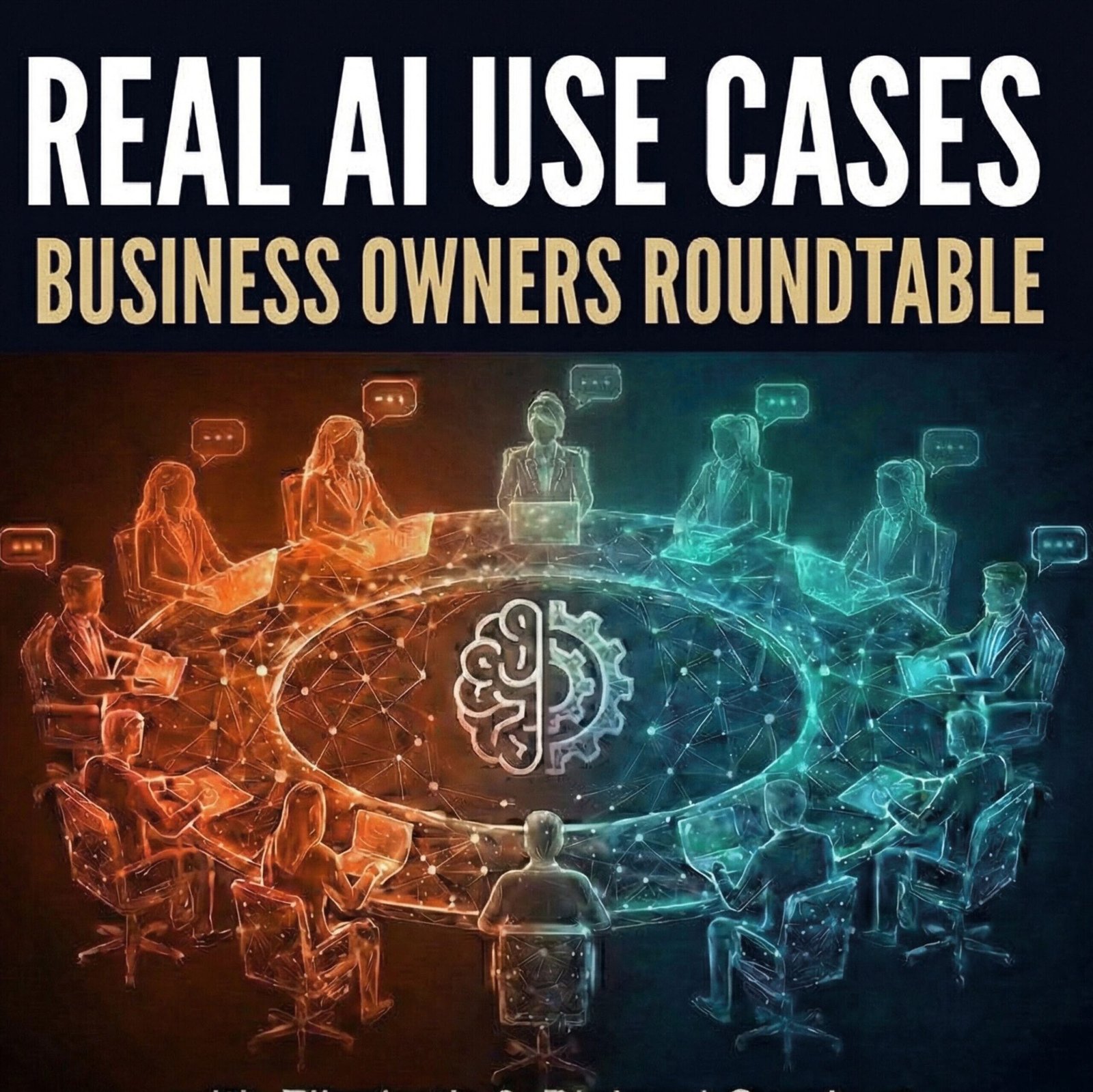
Episode 9 – From Fear to Love: AI Mindset

In this episode of the Business Owners Roundtable, hosts Elizabeth Gearhart and Richard Gearhart sit down with a panel of experts to discuss the practical, “in-the-trenches” applications of artificial intelligence. We move past the theoretical to show you exactly how AI is being used to verify facts, save time, and grow businesses.

Real AI Use Cases — Business Owners Roundtable | Episode 9

Featuring: Saahil Mehta, Brady Sticker & Tom Wragg
Hosted by Elizabeth Gearhart & Richard Gearhart


TL;DR

Business owners reveal the AI tools they’re using right now — a personal AI chatbot trained on your own content, a team efficiency system powered by ChatGPT prompts, AI-driven mortgage automation, and even AI-assisted weight loss as well as deep research. The takeaway: stop fearing AI and start using it to multiply what you can do.


What does AI actually look like inside a real business — not in theory, but today? In this episode of Real AI Use Cases: Business Owners Roundtable, host Elizabeth Gearhart brings together three entrepreneurs to share exactly how they are putting AI to work, what’s working, and what they see coming next.

Saahil Mehta built a custom AI chatbot trained entirely on his own public content, research, and posts — so his team and coaching clients worldwide can get answers from “Sahil Bot” even when he’s asleep. Brady Sticker of Church Candy transformed his company culture around AI by giving every employee a ChatGPT prompt to build their own personal AI efficiency plan — now one team member does the work of three or four. Tom Ragg of loanDepot uses AI across the entire mortgage loan life cycle, from lead generation and income analysis to birthday messages and social media — automating customer retention while he sleeps. And Richard Gearhart of Gearhart Law discovered an unexpected AI use case: losing two pounds in four days by tracking meals with AI.

The conversation goes deeper than just tools. The group tackles the big question everyone is asking — will AI take our jobs? — with Richard raising a nuanced concern about junior attorneys losing the experience pipeline, Tom arguing that high-stakes, trust-based relationships will always need a human, and Saahil offering a powerful mindset reframe: every major technological breakthrough in history has created as many opportunities as it displaced. You can face that reality from a place of fear, or from a place of love.

Whether you’re a business owner just starting to explore AI or already building automations for your team, this episode is packed with practical, actionable ideas you can implement this week.


What You’ll Learn

  • How to build a custom GPT trained on your own content and set guardrails so it stays on-topic
  • The exact ChatGPT prompt Brady used to help every employee create their own AI efficiency plan
  • How AI is being used in mortgage origination to automate lead gen, CRM, and customer follow-up
  • Why the most important AI skill is knowing how to craft the right query
  • How experienced professionals can stay relevant as AI handles routine tasks
  • Why the jobs-vs-AI debate may be asking the wrong question entirely
  • Saahil Mehta — Coach, speaker & entrepreneur | sahilmata.com
  • Brady Sticker — Founder, Church Candy | churchcandy.com
  • Tom Wragg — Mortgage Originator, loanDepot | loandepot.com

Resources Mentioned

  • ChatGPT (OpenAI) — Custom GPT builder
  • Perplexity AI — LLM-based research tool
  • Google Gemini — AI research assistant
  • Descript — Podcast editing with AI transcription

Real AI Use Cases is produced by Elizabeth Gearhart, podcast consultant, PhD researcher, and host. New episodes feature real business owners sharing how they use AI right now — no hype, just results.


Frequently Asked Questions

Q: How did Saahil Mehta build his personal AI chatbot?
A: Saahil’s team fed all of his publicly available content — posts, research, interviews, and more — into ChatGPT and built a custom GPT with guardrails. The guardrails prevent the bot from answering questions outside his areas of expertise, keeping responses accurate and on-brand. His team handled the technical architecture, which is a great example of why having an AI implementation team matters.

Q: What is the ChatGPT prompt Brady Sticker used with his team?
A: Brady had every employee submit this prompt to ChatGPT: “I want you to act as an AI and automations expert. Ask me questions about my role, responsibilities, KPIs, and how I’m currently accomplishing all of this. Make sure you have a good understanding of my role, and then create a plan for me on how I can use AI to become more efficient.” Any business owner can use this with their team today.

Q: Can AI really replace a mortgage originator?
A: According to Tom Ragg of loanDepot, AI is amplifying good originators — not replacing them. While AI handles lead generation, CRM automation, income analysis, and follow-ups, high-value transactions still require human trust, relationship management, and negotiation. The larger and more complex the deal, the more essential the human element becomes.

Q: Will AI take jobs away from attorneys?
A: Richard Gearhart of Gearhart Law acknowledges that AI can now complete in seconds what used to take a junior attorney hours — such as drafting contracts and documents. While experienced attorneys who apply judgment and strategy remain essential, Richard’s concern is that fewer junior attorneys will get the hands-on experience needed to develop into senior advisors.

Q: What AI tools do the hosts recommend for research?
A: Elizabeth Gearhart uses ChatGPT, Perplexity AI, and Google Gemini for research. She emphasizes that the most important skill isn’t which tool you use — it’s knowing how to craft the right query. Role-play prompts, such as asking AI to respond as a specific type of person or expert, consistently produce higher-quality, more actionable results.

Q: How can I use AI to track my diet and lose weight?
A: Richard Gearhart logs everything he eats into an AI chat, which calculates calories and macronutrients, suggests future meals based on his remaining daily intake, and gently coaches him when he’s exceeded his goals — all without harsh judgment. He lost two pounds in four days using this method alone.

Q: Should small business owners be afraid of AI replacing their teams?
A: All four guests agree: no. Brady Sticker reframed it best — don’t use AI to replace your team, use AI to make your team more efficient. Saahil Mehta adds that every major technological revolution has eliminated some roles while creating new ones. The mindset you bring to AI matters as much as the tools you choose.

Q: What is a custom GPT and how does a business set one up?
A: A custom GPT is a version of ChatGPT trained on your specific content, documents, or data and configured with instructions that define its behavior and boundaries. Businesses can build one inside ChatGPT’s GPT Builder tool. For more complex implementations — like Saahil’s Sahil Bot — a technical team can set up guardrails and connect it to existing content systems for a more robust experience.

Full Episode Transcript: Real AI Use Cases — Business Owners Roundtable, Episode 9

Show: Real AI Use Cases — Business Owners Roundtable
Episode: 9
Topic: How Real Business Owners Are Using AI Right Now
Host: Elizabeth Gearhart, PhD | Podcast Consultant & AI Researcher
Co-Host: Richard Gearhart | IP Attorney & Entrepreneur, Gearhart Law
Guests: Saahil Mehta (sahilmata.com) | Brady Sticker, Church Candy (churchcandy.com) | Tom Wragg, loanDepot (loandepot.com)
Keywords: AI in business, ChatGPT, custom GPT, AI automation, small business AI, AI productivity, AI coaching, mortgage AI, AI tools, entrepreneur AI, AI jobs, Perplexity AI, AI mindset, large language models, AI efficiency


Introduction

Elizabeth Gearhart: This is Real AI Use Cases Business Owners Roundtable with host Elizabeth Gearhart — podcast consultant, marketing expert, and PhD researcher using AI every day — and Richard Gearhart, entrepreneur, seasoned business owner, and intellectual property attorney specializing in innovation. Here’s how real companies are using AI right now. This is AI in business.

I am here with Saahil Mehta, Brady Sticker, and Tom Ragg.


Saahil Mehta: Building a Custom AI Chatbot Trained on Your Own Content

Elizabeth Gearhart: Saahil Mehta at sahilmata.com — what is one way you are using AI in your business?

Saahil Mehta: I’ve created a Sahil Bot. I’ve put in everything I’ve ever said in the public domain — all my research, all my posts, everything — and I fed that all into ChatGPT. How that’s helping is my team doesn’t always have to depend on me to get an answer. In fact, I would even go as far as saying that Sahil Bot is probably better than I am, because it doesn’t forget anything I’ve ever said.

Elizabeth Gearhart: The second person that I’ve heard do this. How much time do you think that saves?

Saahil Mehta: Every time my team has to depend on an answer from me, now they can just go to Sahil Bot and ask the question and it’ll respond on my behalf.

Elizabeth Gearhart: So they don’t have to track you down, they don’t have to write an email back. Wow.

Saahil Mehta: And it’s not just internal — it’s even external. The folks who coach with me, in between sessions, because I coach people around the world — what if I’m sleeping? They can go to Sahil Bot, ask the question, and get an answer.

Elizabeth Gearhart: So how did you implement that? Is there special software that helps people create their own bot inside ChatGPT, or did you just start feeding it your data?

Saahil Mehta: This is where I have to give my team credit. The folks who manage my website and the back end of everything I do — I’m going to be honest and say I don’t have all the details. However, I do know that they fed all my content into ChatGPT and put in some guardrails. Because if you ask about mortgages, for example, my bot will say, “I’m sorry, I’m not an expert in that field. Please ask another question.” That’s what I mean by guardrails — as opposed to being completely open to answering anything.


Brady Sticker: Using AI to Multiply Team Efficiency

Elizabeth Gearhart: Brady Sticker with churchcandy.com — what’s one way you’re using AI in your business?

Brady Sticker: When AI first really came on the scene, I was a little intimidated. People were saying you don’t have to have your employees do all this stuff anymore — you can just have AI do it. We have a pretty big team and a great company culture and I didn’t want to replace my team with AI. One of my business coaches really helped me change my mindset. Don’t use AI to replace your team — use AI to make your team more efficient.

Now, one of my team members — with the help of AI — has the efficiency of three or four team members. Here’s a practical thing we did to implement this. We basically had all of our team take this prompt and give it to ChatGPT:

“I want you to act as an AI and automations expert. Ask me questions about my role, responsibilities, KPIs — key performance indicators — and how I’m currently accomplishing all of this. Make sure you have a good understanding of my role, and then create a plan for me on how I can use AI to become more efficient.”

We had our entire team do this across the company. Now we have a custom ChatGPT bot that takes all of our proven ad copy templates and scans our client’s website to write custom copy for them. Instead of my team spending several hours researching the client and rewriting templates, ChatGPT does it in seconds.

Elizabeth Gearhart: That’s great.

Brady Sticker: They love it because it’s making their job easier. They’re hitting higher numbers. Rather than being scared of AI taking their job, they’re embracing it — and it’s made us as a company way more efficient.


Tom Wragg: AI in Mortgage Origination and Customer Retention

Elizabeth Gearhart: Tom Ragg with loandepot.com — what’s one way you’re using AI?

Tom Wragg: AI has become very quickly, very influential. Mortgage originators can use AI across the entire loan life cycle to close more loans faster with less friction while staying compliant — which is a big piece of what we do. AI helps with lead generation, prospecting new clients, new borrowers, new realtors — which is where a lot of us get our origination business. AI also helps analyze income, asset verification, and personalize follow-ups with specific customers.

Elizabeth Gearhart: One way?

Tom Wragg: I would technically say a lot of ways, but it’s all really rolled into origination and customer retention. Making sure that you keep in touch with past customers — because we all have CRM — but AI doesn’t nap, sleep, or get tired. So when it’s someone’s birthday and I’m asleep, AI can wish them happy birthday, keeps in touch with them, and it makes me look like I’m awake when I’m not. It also helps with social media posts, email campaigns, and first-time homebuyers. With my business specifically, it’s really helped me automate customer retention and make new customers happy with a smooth, seamless process to get to the closing table.

Elizabeth Gearhart: I’d be scared if I was your competitor. You’re doing a lot with it and anybody that’s not is falling way behind.


Richard Gearhart: AI for Nutrition Tracking and Weight Loss

Elizabeth Gearhart: Richard Gearhart with Gearhart Law — what’s one way you’re using AI?

Richard Gearhart: I’ve lost weight using AI. I started tracking all my meals in AI and it creates a list of what I’ve eaten, the calories, the macronutrients, and then it suggests dinner possibilities. I’ve been doing this for four days and I’ve lost two pounds. I’ll put in that I had a couple of sugar cookies, and it says, “Okay, you’ve had enough cookies for today.” It coaches you and discourages you from overeating. And if you eat more anyway, it says, “No judgment, but I think you’ve had enough if you want to reach your goals.” It’s been great — a perfect use for AI.


Elizabeth Gearhart: AI for Research and the Power of Prompting

Elizabeth Gearhart: I’ve been using AI extensively for research — not just ChatGPT. I also use Perplexity AI and Google Gemini. In Perplexity you can access Claude and different large language models. What I’m finding is the most important part of AI research is knowing what queries to come up with. I love what Brady said — pretend like you’re this person, then give me an answer that works. I’m going to put a presentation through AI and say, “Pretend like you’re an audience member — am I losing you halfway through?”


Roundtable Discussion: Will AI Replace Jobs?

Elizabeth Gearhart: What do you see AI doing in the future? Do you think it’ll displace your employees?

Richard Gearhart: I think some, depending on the role. In the legal profession, there are a lot of attorneys who are concerned — especially younger attorneys, where their time is spent drafting contracts and documents. What used to take a young attorney three or four hours can now be done in seconds. There’s still a role for experienced professionals to review work and apply judgment. But what I get concerned about is that there won’t be enough young attorneys who work through the system and develop the experience to give good guidance.

Elizabeth Gearhart: I think the people who are going to have jobs in the near term are going to be the people who can introduce AI to businesses and help them do automations. That’s why I was asking you, Saahil, about how you actually did it in your business. You had a team that worked on that, right?

Saahil Mehta: It was a team that put it all together. It’s almost like you have a team that are the architects — they execute on the plan. But I want to say: with everything that comes out in the world, there’s always an element of love and there’s an element of fear. There’s always duality. Whether it was the industrial revolution or nuclear energy — any major breakthrough has caused a lot of benefit, but also a lot of pain. Each day you have a choice of how you wish to show up. You can operate from a place of fear thinking the world’s falling apart, or you can operate from a place of love. I feel you operate at a much better frequency when you’re operating from a place of love. Yes, I see AI taking roles away — but there will be new roles created and new opportunities that come up as a result.

Elizabeth Gearhart: That’s what I think. And Tom — the jobs are going to change. You don’t see people driving horse carriages everywhere anymore. Those people had to learn to drive a car. Their job changed, but things didn’t disappear. What do you think, Tom?

Tom Wragg: AI will not replace trust building or structuring complex deals. It certainly will not replace negotiating terms of contracts between people, and it will never replace person-to-person, realtor-to-mortgage-originator relationships. AI is amplifying good originators, but not replacing us. Once you get into the $500,000 to multi-million dollar transactions, people want a human being on the other side of the phone — because the implications of making the wrong decision are much greater.

Elizabeth Gearhart: I agree strongly with Saahil. I don’t think we need to be afraid. We’re not all going to be sitting in line at the soup kitchen because of AI. We’ll find creative ways to use it. Things will shift, but humanity will shift with it.


Closing

Elizabeth Gearhart: You have been listening to Real AI Use Cases Business Owners Roundtable.

Optimized using Claude Sonnet 4.6 Thinking