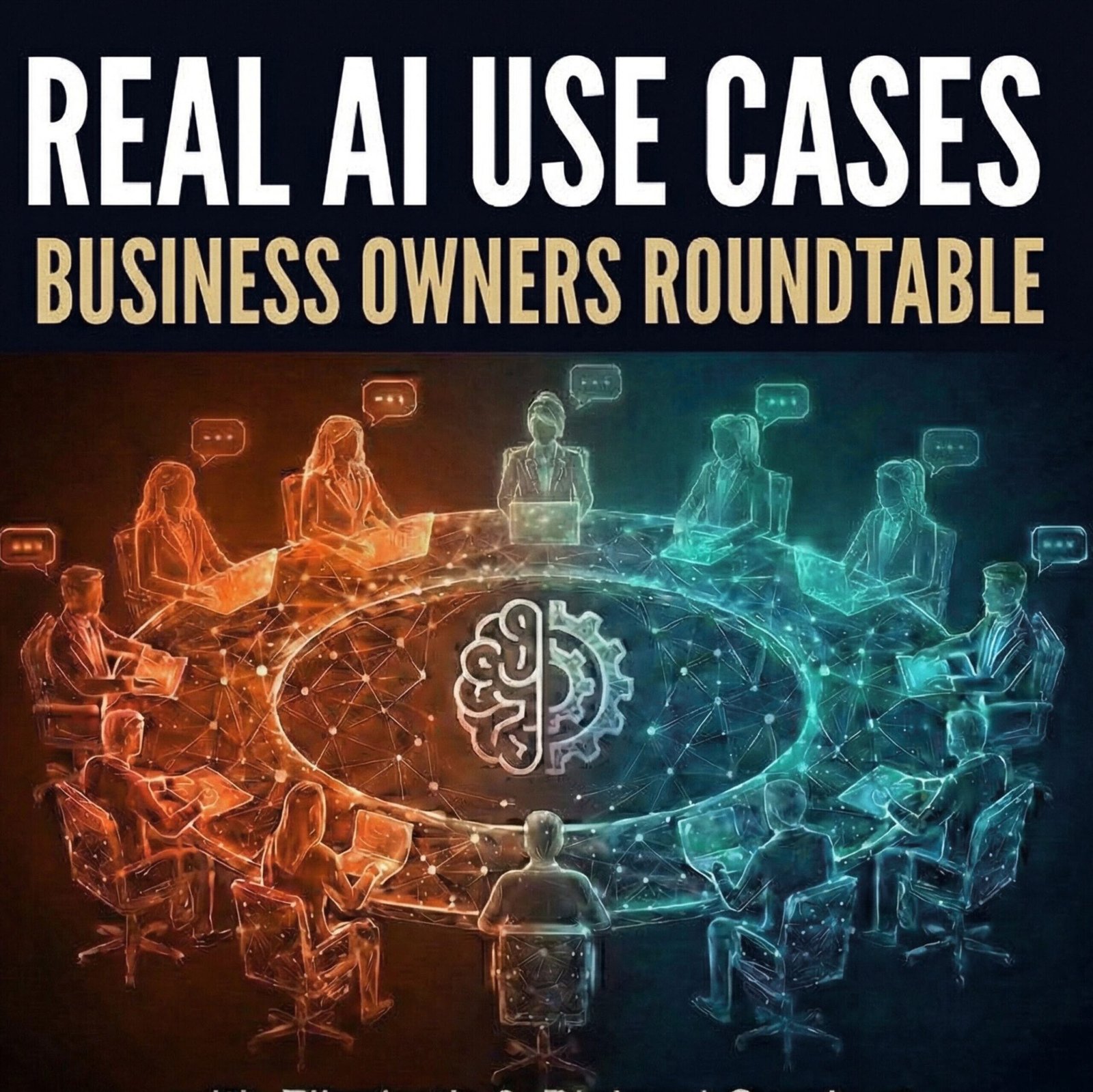
Episode 10 – AI in Action: Small Business Owners Share What’s Actually Working
17 min · March 13, 2026
Business owners on predicting addiction risk with AI, keeping enterprise data private, and what it feels like to talk to an AI clone of yourself.
Key Takeaways
- AI can integrate genomics, brain scans, health records, and behavioral data into a single risk profile — the kind of comprehensive analysis that simply wasn’t possible with older, hypothesis-driven research methods.
- Every major LLM trains on the data you give it — so for real privacy, sensitive fields like law, wealth management, and healthcare need a private, confidential layer rather than a public chatbot.
- “Deep research” prompts that take longer to run tend to produce noticeably richer, more useful results than quick one-shot requests.
- A full speaker list or 100 podcast episodes fed into AI can turn hours of manual sorting into a ready-made shortlist of the right people to connect with.
- AI pricing is shifting from per-seat subscriptions toward usage-based platform licenses, especially for larger companies.
- AI clones trained specifically on one expert’s own writing and voice — not the whole internet — can give people meaningful access to that person’s specific expertise, even when they’re not available.
Main Topics
See how AI integrates genomics, health records, and behavioral data into real risk profiles.
Learn why confidential, privacy-first AI matters most for law, wealth, and healthcare data.
Discover what it’s actually like to talk to an AI trained specifically on your own voice and work.
Featured Guests


Meet the Hosts

Elizabeth Gearhart, Ph.D. is the host of Real AI Use Cases: Business Owners Roundtable, where she explores how businesses are actually putting AI to work. She is also CMO of Gearhart Law and co-host of the nationally syndicated Passage to Profit radio show and podcast.

Richard Gearhart, Esq. is co-host of Real AI Use Cases: Business Owners Roundtable and founder of Gearhart Law, a full-service intellectual property law firm. A longtime podcaster, he hosts Intellectual Property News and is the host of the nationally syndicated Passage to Profit radio show and podcast.
From predicting addiction risk to protecting client-confidential data to meeting an AI trained on your own voice, this episode is a reminder that the barriers to using AI as a small business are lower than most people think.
Episode Summary
Elizabeth and Richard Gearhart lead a roundtable on AI at very different scales. Dr. Danielle Dick uses AI to integrate genomics, brain scans, and health records into addiction-risk profiles at ThriveGenetics.ai; Neil Senturia built AskTuring.ai to give wealth managers, law firms, and CPA firms a private, multi-model way to use AI on confidential data; and Alan Porter uses ChatGPT’s deep research and AI video tools like HeyGen to attract new clients at Strategic Wealth Strategies.
The conversation moves from public-data use cases — like Richard using AI to shortlist conference connections — to the deeper value of private data, and closes with Dr. Dick’s account of speaking with an AI trained specifically on her own voice and work, a preview of how personalized AI expertise may become.
Frequently Asked Questions
How is AI used to predict addiction risk?
What is confidential RAG, and why does it matter for enterprise AI?
What is “deep research” in ChatGPT, and how is it different from a normal prompt?
Will AI pricing stay per-seat, or is that changing?
What does it mean to create an “AI clone” of yourself?
Episode Transcript
View Full Transcript
Elizabeth Gearhart, Ph.D.: Welcome to Real AI Use Cases Business Owners Roundtable. I’m Elizabeth Gearhart, podcast consultant, marketing expert, and Ph.D. researcher using AI every day, here with my co-host Richard Gearhart, entrepreneur, seasoned business owner, and intellectual property attorney specializing in innovation. We want to show business owners that real people are using AI right now — the barriers to trying it yourself are very low.
Elizabeth: Dr. Danielle Dick, what’s one way you use AI to help ThriveGenetics.ai run better?
Dr. Danielle Dick – Integrating Data for Addiction Risk: Our business is grounded in research, and we use AI and machine learning to integrate a huge range of data on individuals — genomics, transcriptomics, proteomics, metabolomics, digital health monitoring, brain scans, electronic health records, and personal surveys. AI lets us combine all of that to predict treatment outcomes and identify who’s most at risk of developing addiction, and we keep iterating on those risk profiles at Thrive Genetics. This kind of integration simply wasn’t possible with the more narrow, hypothesis-driven research of the past — addiction and mental health are complex enough that we genuinely need comprehensive profiles built from enormous amounts of data.
Elizabeth: Neil Senturia, your whole company is AI — what’s one way you’re using it to speed up processes?
Neil Senturia – Private, Multi-Model AI: AskTuring.ai is built specifically for confidential, privacy-focused retrieval augmented generation — RAG — with large data. We named it after Alan Turing, who broke German communications encryption in World War II. Right now there are seven, eight, nine major LLMs, and all of them train on whatever data you give them — so if you show one your genetics or medical records, that data isn’t private anymore. We built a middleware layer that lets you keep your own private data while still accessing any of a dozen different LLMs, since Claude is better at some tasks and Gemini at others. Our real differentiator is context and memory that current offerings don’t provide. Our customers are wealth managers, lawyers, and manufacturing firms.
Elizabeth: And how do you personally use it at Ask Turing?
Neil: The same way anyone uses ChatGPT — we just believe ours is better and gives people the privacy they actually want. When I talk to people, they tell me they use ChatGPT or Claude but know it isn’t private, so they never load their sensitive documents. That’s exactly the problem we solve.
Elizabeth: Alan Porter, what’s one way you’re using AI at Strategic Wealth Strategies?
Alan Porter – Deep Research and AI Video: When I ask ChatGPT to do something, I ask for deep research specifically — it takes a little longer than a normal prompt, but the results are much richer. I also use AI agents for video content: I’ve made over 500 videos myself, and about 20 more recently with HeyGen. The AI-produced ones actually look more polished — no filler words, no pauses — and it’s made a real difference in the new clients I’m attracting.
Neil: What Alan’s doing is a great example of using AI well. We work with four large CPA firms facing that exact challenge — large amounts of data that need both privacy and precision.
Elizabeth: Richard, how are you using AI at Gearhart Law?
Richard Gearhart – Finding Connections at a Conference: We’re attending a conference next week, and I wanted to get organized on who’d be there. I put the full speaker list into ChatGPT and asked it to identify people who’d be good connections — either as potential podcast guests or for business. I described what makes a good podcast guest, and it came back with about 20 strong matches.
Neil: That’s a perfect example of using public data — ChatGPT handles that easily. But the real power is in private data. You could take 100 of your own podcast episodes, put them into Ask Turing, and use RAG to chat with your entire back catalog. The magic is in your private data, not the public information.
Richard: I think it’s really both — what I did worked well, and I also see the value of private data analysis, especially for a law firm where client confidentiality is critical. Our strategy is to use outward-facing tools like ChatGPT for anything non-confidential, and Microsoft Copilot through our enterprise 365 account — which won’t share our data — for internal review.
Elizabeth – Marketing Without Confidential Data: None of what I do involves confidential information, so I run marketing reports through AI and simply anonymize the data first — no names. It saves an enormous amount of time. I’m mostly using Google Gemini right now since their latest upgrade improved accuracy, and I also use AI as a consultant while building out a website, bouncing between ChatGPT, Gemini, and Perplexity whenever I get stuck.
Neil – Where AI Pricing Is Headed: Looking ahead, pricing is going to change — companies will be forced toward usage-based billing instead of per-seat. If you have a thousand employees, you’re not paying thirty dollars a seat for all of them; you buy a platform license and pay based on actual consumption.
Elizabeth: That works for businesses, but it’ll be harder to get consumers who are used to free Google search to start paying. Some analysts think that by 2028 more people will start with ChatGPT and other LLMs before Google — and once that crosses over, Google may start charging too. We’ve had a long run of a free internet, but that may not last.
Dr. Dick – Meeting Her Own AI Clone: I want to share one more experience. I’m on the advisory board of a parenting-space startup that built a panel of founding experts, including an AI version of me trained on roughly two percent of my public podcasts. In a demo, I asked it a question and got an answer back in my own voice and intonations, based on things I’d actually written and said. It was genuinely wild — and it made me think about the potential for AI to give people access to an expert trained specifically on that person’s own research and work, not the whole internet.
Richard: Did it give the answer you actually would have given?
Dr. Dick: It did — of course, since it was trained on me. I imagine it’s something like what having an identical twin must feel like.
Elizabeth: We’ve actually had guests on this show who’ve cloned themselves for their companies — employees are required to ask the AI clone first, and only come to the CEO directly if the clone can’t answer.
Dr. Dick: I love that idea.
Closing – Elizabeth: Thank you for listening to Real AI Use Cases Business Owners Roundtable. We hope you found this valuable — join us again for more stories, because the future of business is driven by AI. This podcast was recorded at iHeart Studios in Manhattan as part of the Passage to Profit Radio Show.
Keep exploring the show
Hear how more business owners are putting AI to work in their day-to-day.