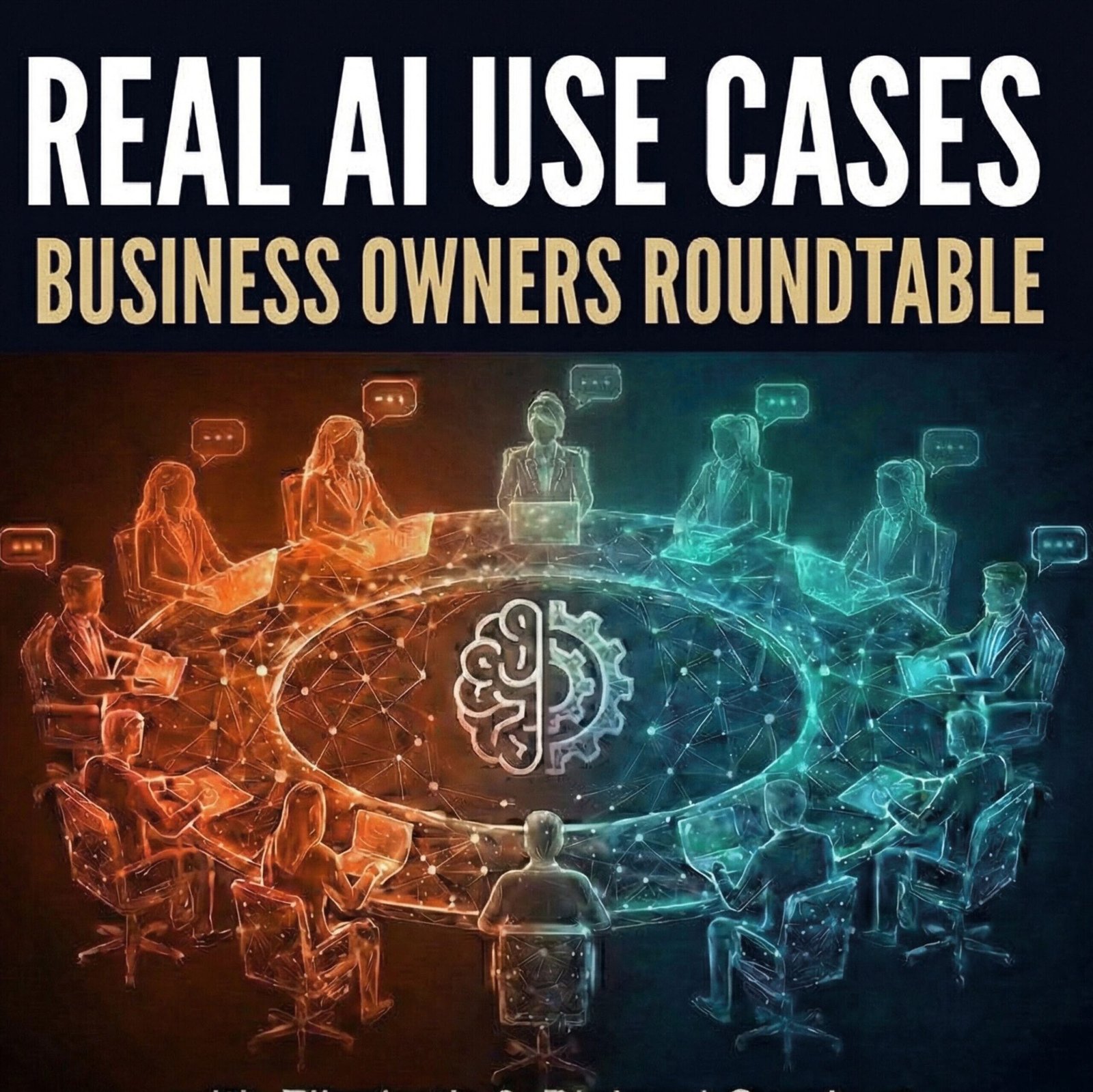
Episode 2 – Are You Ignoring Your Most Powerful Data Tool?
11 min · January 13, 2026
A roundtable on how AI is changing research, communication, data analysis, and the future of work — with real business owners sharing what’s actually working.
Key Takeaways
- AI-powered search delivers faster, more unbiased answers than scrolling through search results and reviews.
- AI helps people with learning differences or ADHD express ideas more clearly by turning outlines into polished writing.
- Running call transcripts through AI surfaces patterns across past conversations and helps prepare for future meetings.
- AI can analyze massive, complex data sets — from reptile conservation metrics to website analytics — to guide real business decisions.
- The real advantage isn’t replacing people with AI; it’s redeploying talent so employees focus on higher-value work.
- Guests rely on a mix of AI tools — including ChatGPT, Perplexity, Claude, and Gemini — choosing whichever fits the task, from research to meeting summaries to spotting psychological themes in coaching calls.
- Comparing European and U.S. approaches to AI adoption shows a common thread: companies seeing the best results use AI to free people for higher-value work, not just to cut headcount.
Main Topics
See how AI-powered search replaces scrolling through results to get faster, unbiased answers.
Learn how AI helps turn outlines and rough ideas into clear, confident writing.
Discover how AI connects patterns across data sets that would be nearly impossible to spot manually.
Featured Guests


Meet the Hosts

Elizabeth Gearhart, Ph.D. is the host of Real AI Use Cases: Business Owners Roundtable, where she explores how businesses are actually putting AI to work. She is also CMO of Gearhart Law and co-host of the nationally syndicated Passage to Profit radio show and podcast.

Richard Gearhart, Esq. is co-host of Real AI Use Cases: Business Owners Roundtable and founder of Gearhart Law, a full-service intellectual property law firm. A longtime podcaster, he hosts Intellectual Property News and is the host of the nationally syndicated Passage to Profit radio show and podcast.
Every week we hear different answers, because everyone is using AI in different ways — the future of business is being shaped right now, and AI is a major part of that.
Episode Summary
Elizabeth and Richard Gearhart lead a roundtable exploring how AI is changing research, communication, data analysis, and the future of work. Mark uses AI-powered search for faster, unbiased research; Gary runs client call transcripts through AI to sharpen his coaching; and Tim applies AI to everything from reptile conservation data to tourism analytics.
The throughline of the episode: AI works best as a thinking partner that amplifies human intellect, not a replacement for it — and that mindset is becoming a real competitive advantage for attracting and keeping great talent.
Frequently Asked Questions
What is this episode of AI in Business: Use Cases From the Real World about?
How are businesses using AI for research in this episode?
How does AI help with accessibility and communication?
How are transcripts and past conversations used with AI?
How is AI used for data analysis in real businesses?
Does this episode suggest AI will replace jobs?
What tools are mentioned in this episode?
Who should listen to this episode?
What makes this podcast different from other AI shows?
Episode Transcript
View Full Transcript
Elizabeth Gearhart, Ph.D.: Welcome to AI in Business: Use Cases From the Real World. I’m Elizabeth Gearhart, podcast consultant, marketing expert, and Ph.D. researcher using AI every day.
Richard Gearhart: And I’m Richard Gearhart, entrepreneur, seasoned business owner, and intellectual property attorney specializing in innovation.
Elizabeth: On this show, we explore how real companies are using AI right now. We’re going to segue into a roundtable discussion and ask everyone one simple question: What is one way you’re using AI in your business today?
Mark Weinstein – AI Search and Unbiased Research: I’ve written a lot about AI, including pieces on regulation that were published on Fox. I still like to be creative myself, so I don’t use AI for writing, but I use it heavily for research. AI search is incredibly valuable. Whether I’m researching people I want to connect with, products I’m buying, or diagnosing something like what’s wrong with my car, AI search gives me unbiased input much faster. In the past, we had to scroll through search results and reviews. Now AI tells you directly what mattress to buy or what might be wrong with your transmission. It’s a much more effective way to research.
Gary B. Cohen – Expression, Coaching, and Accessibility: Listening to this conversation brought me back to my time at the ESPN Institute, when large language models were just becoming public. Growing up with learning differences, there was often a gap between what I wanted to express and what actually came out. AI has changed that. You can outline what you’re thinking and then see it written out clearly, exactly as you intended. Many of my clients have ADHD or other learning challenges. AI helps them express themselves more fully and clearly. In my business, all my calls are transcribed and run through ChatGPT. With the right prompt, it reviews past conversations, identifies what’s on track or off track, and prepares topics for the next call, including psychological and coaching insights. It’s incredibly powerful.
Tim Nealon – Data Analysis for Business Decisions: We’re building AI into everything we do. I’m known for Ghost City Tours, but one of my main applications is in a reptile conservation center I own. We breed critically endangered reptiles. Each animal has thousands of data points over its lifetime. By integrating AI into our software, we can analyze that data to understand what keeps these animals alive and how to successfully produce future generations. We use AI similarly in our tourism business—analyzing Google Analytics, Search Console, booking data, and more. AI connects data points that no human could realistically connect on their own, helping us make better business decisions. We’re not just asking AI to write things—we’re using it to analyze complex data and guide strategy.
Group Discussion – Elizabeth: I recently spoke with someone in Europe about how their company is implementing AI. Instead of cutting jobs, they’re using AI to automate routine tasks so employees can spend more time with customers and driving growth. In the U.S., the narrative is often about job cuts. But AI doesn’t have to be a job destroyer—it can be a way to redeploy talent more effectively.
Richard: If companies provide incentives for adopting AI and reassure employees that their jobs aren’t disappearing, adoption happens faster. You may even attract better employees—people who want to combine AI with their intellectual skills.
Elizabeth – Content Repurposing and Events: I’ll share a recent example. I hosted a meetup and recorded it on Zoom. I edited the video in Descript, then took the transcript and ran it through ChatGPT. I asked it to generate a recap email, including links to podcasts, tools, and resources mentioned during the event. That would have taken hours manually. AI reduced it to about an hour, with the longest part being downloading and processing the files.
Closing – Elizabeth: You’ve been listening to AI in Business: Use Cases From the Real World. Every week, we hear different answers because everyone is using AI in different ways.
Richard: The future of business is being shaped right now, and AI is a major part of that.
Keep exploring the show
Hear how more business owners are putting AI to work in their day-to-day.