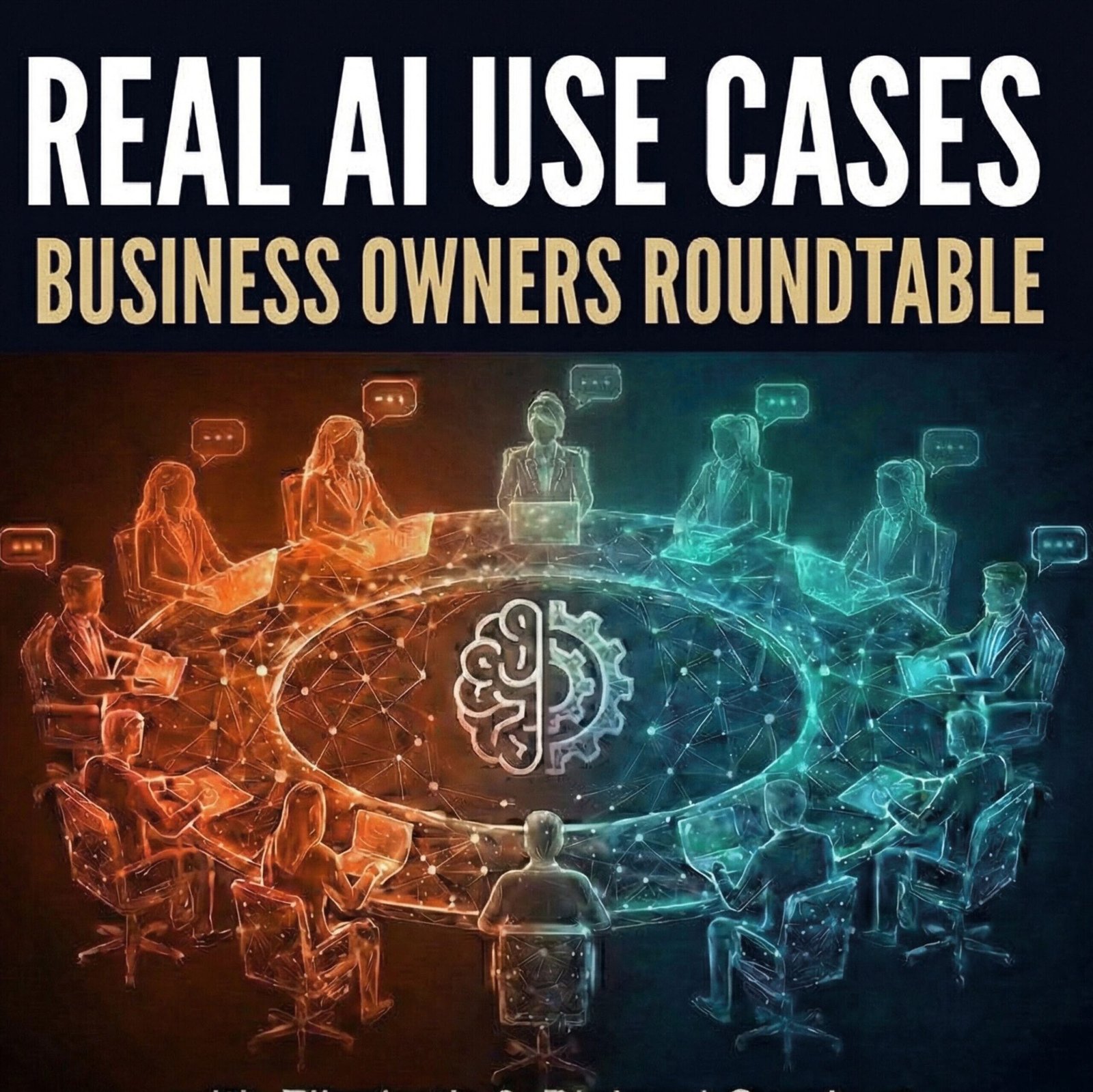
Episode 1 – How Does AI Give Business Owners More Time?
18 min · January 13, 2026
Real business owners share the AI workflows they’re using to save time, improve decisions, and work smarter.
Key Takeaways
- A solo marketer uses a personal AI tool (“Artie Inga”) to draft client emails and proposals in minutes instead of hours.
- A wealth planning firm uses private AI to turn meeting notes into clear, jargon-free action timelines for clients.
- A fast-growing startup trained an internal AI on 600+ meeting transcripts so employees can get “pre-vetted” answers before escalating to leadership.
- Better AI results come from iterative prompting — asking follow-up questions and requesting a “devil’s advocate” critique — rather than one-shot prompts.
- AI adoption isn’t about cutting jobs; it’s about freeing skilled people to focus on higher-value work.
Main Topics
See how AI is being used to write emails, proposals, and follow-ups.
Learn how companies are using private AI systems to summarize meetings and support executives.
Learn why iterative prompting and AI “devil’s advocate” techniques outperform one-shot prompts.
Featured Guests


Meet the Hosts

Elizabeth Gearhart, Ph.D. is the host of Real AI Use Cases: Business Owners Roundtable, where she explores how businesses are actually putting AI to work. She is also CMO of Gearhart Law and co-host of the nationally syndicated Passage to Profit radio show and podcast.

Richard Gearhart, Esq. is co-host of Real AI Use Cases: Business Owners Roundtable and founder of Gearhart Law, a full-service intellectual property law firm. A longtime podcaster, he hosts Intellectual Property News and is the host of the nationally syndicated Passage to Profit radio show and podcast.
If you’re experimenting with AI at work, listen to this episode and borrow one workflow to implement this week—then test it with iterative prompts and a devil’s advocate round.
Frequently Asked Questions
How are business owners using AI to save time right now?
What’s one practical way to use AI for client communication?
Can AI write proposals for my business?
How do companies use AI to summarize meetings without overwhelming clients?
What is a “private AI bot” and why would a business use one?
What does it mean to train a bot on meeting transcripts?
Why do iterative prompts work better than “one-shot” prompts?
What is the “devil’s advocate” prompting method?
What are “hallucinations” in AI, and how do you reduce them?
Which AI tools were mentioned in this episode?
Why should businesses learn AI now instead of waiting?
Is AI mainly about replacing jobs?
Episode Transcript
View Full Transcript
Elizabeth Gearhart, Ph.D.: Welcome to AI in Business: Use Cases From the Real World. I’m Elizabeth Gearhart, podcast consultant, marketing expert, and Ph.D. researcher who uses AI every day.
Richard Gearhart: And I’m Richard Gearhart—entrepreneur, seasoned business owner, and intellectual property attorney specializing in innovation.
Elizabeth: On this show, we ask real business owners and leaders one simple question: What is one real way you’re using AI in your business right now that’s actually helping you? Let’s get started.
Tommy Hilcken – Marketing Entrepreneur: I’m a one-man show. I’ve always been a one-man show, and it’s exhausting. I run a marketing company called Artie Inga—AI. I joke that I have a marketing guy named Artie Inga, and his initials are AI. If someone sends me an email asking for something specific, I drop it into AI and ask it to respond professionally, but with humor. It writes responses better than I ever could. I’ll even ask it to write proposals. I prefer talking to clients, but some people want things in writing, and AI produces clean proposals with bullet points outlining exactly what I’m going to do. It’s incredible. For me, AI is like driving a car instead of walking—it cuts the time by ten times.
Bobby Mascia – Green Ridge Wealth Planning: If you’re not embracing AI right now, especially if you’re older in business, your ability to transact and retain value in the future is going to be dramatically reduced. One of the main ways we use AI is summarizing client meetings. With client approval, we capture conversations and use a private AI system to extract what’s important—key points, action items, and timelines. Clients don’t want jargon. They want clarity. AI helps us take complex financial concepts and simplify them into clear, actionable summaries. Prompting matters. You can’t just ask one question. You need to guide the AI—have it research your firm, understand your team, then perform tasks step by step. That’s how you reduce hallucinations and get real value.
Josh Khan – Eden: We scaled past 150 employees largely because we adopted AI early. I’m in an executive role, and people constantly come to me for decisions they already know the answer to. So we took transcripts from over 600 meetings I attended and uploaded them into a private AI system. Now, before anyone comes to me, they run their question through that system. They come back with a plan already vetted based on how I think and make decisions. It knows my priorities, my P&L, my people challenges—it’s thinking while I sleep. I wake up with a curated list of what I should focus on that day. AI doesn’t replace thinking—it amplifies it.
Richard Gearhart – Gearhart Law: We’re planning to train everyone in our firm on how to write effective prompts so they can use AI productively in their daily work. A lot of people say they use AI, but mostly for personal tasks. They’re not using it to improve how they work.
Elizabeth: I use multiple tools—ChatGPT, Claude, Perplexity, Gemini—because different tools are better for different tasks. AI recently helped me identify serious problems with a website that had been built for us. What I love about this show is that every week we get different answers. AI keeps evolving, and the creativity comes from how humans ask questions.
Group Discussion – Elizabeth: AI is only as good as the questions you ask. Better questions lead to better answers—just like with people.
Josh: Exactly. Ask it to play devil’s advocate. Add stakes to your prompts. Tell it the outcome matters. You’ll get stronger responses.
Bobby: If you engage with AI instead of letting it think for you, you retain more knowledge and make better decisions.
Tommy: You have to master it now. Don’t let it master you.
Closing – Elizabeth: The message is clear: start now. The people who win will be curious, adaptable, and willing to learn. Thank you for listening to AI in Business: Use Cases From the Real World.
Keep exploring the show
Hear how more business owners are putting AI to work in their day-to-day.