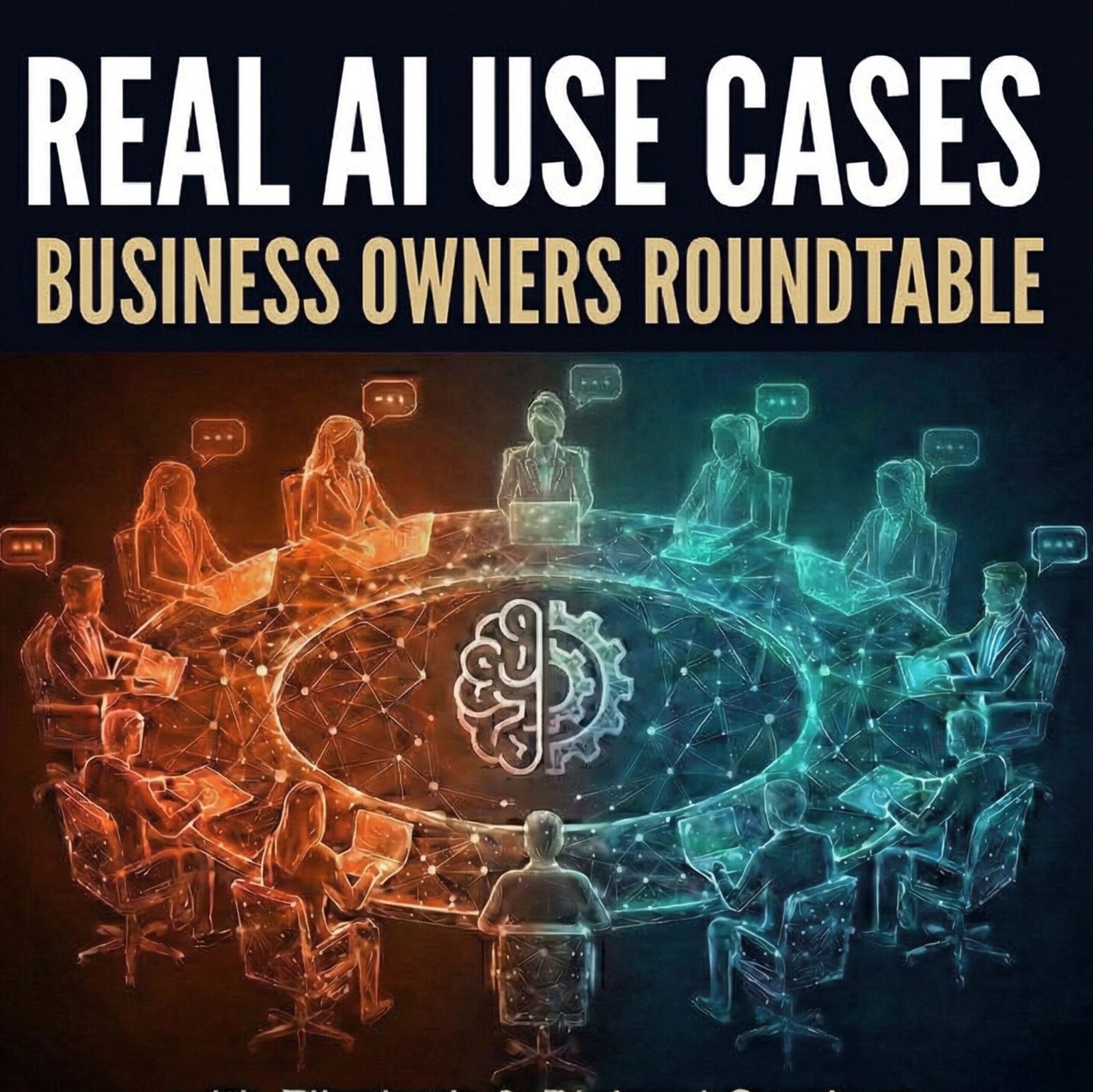
AI in the Real World: Practical Business Strategies, Avoiding Slop, and Finding Brevity
14 min · September 3, 2026
A speaker, a fitness expert, a real estate and wealth professional, and the hosts on AI as editor, expertise magnifier, hiring screen, slide builder, and the case for brevity.
Key Takeaways
- Craig Smith uses AI as a research tool and as an editor, asking it to sizzle or trim his writing, and says the question he used to ask friends about what they were watching has become what they are using AI for.
- Chris Ryan says AI magnifies expertise, like an octopus with multiple tentacles, helping with content, idea generation, and outlines, and challenging you back with hard questions. He also uses it as a high-end research tool for family planning, such as finding summer camps.
- Jeff Sibel creates weekly content for his real estate brokerage, which just acquired RE/MAX, by going back and forth between Claude and ChatGPT to tie financial planning to real estate and then asking for illustrations to keep realtors engaged.
- Richard Gearhart runs hiring candidates’ work product through AI to see if it looks AI-generated, then asks whether they used AI. He encourages AI use but wants people to understand the basics of what they are doing.
- Elizabeth Gearhart says ChatGPT makes eye-catching slides but crams in too much, and that a small edit box on generated images now allows very fine changes, such as adding red devil horns and a tail to a robot without changing anything else.
- The group agrees on brevity: AI is wordy and produces slop that costs you an authentic connection, so Richard wants a mode that cuts the context, and Elizabeth says specific prompts save tokens and avoid putting garbage in your own database.
- Craig and Chris say AI learns you, like training a puppy, while Richard says ChatGPT sucks up to him, and Elizabeth says that to get unbiased information someone else almost has to ask it, and that she tells it to keep her voice when optimizing posts.
Main Topics
Hear how AI works as an editor, a research tool, and a way to challenge your own thinking.
Learn why AI slides and answers get too wordy, and why brevity builds an authentic connection.
See how AI is used to check candidates’ work, and why AI flattery and personalization can skew answers.
Featured Guests
Meet the Hosts

Elizabeth Gearhart, Ph.D. is the host of Real AI Use Cases: Business Owners Roundtable, where she explores how businesses are actually putting AI to work. She is also CMO of Gearhart Law and co-host of the nationally syndicated Passage to Profit radio show and podcast.

Richard Gearhart, Esq. is co-host of Real AI Use Cases: Business Owners Roundtable and founder of Gearhart Law, a full-service intellectual property law firm. A longtime podcaster, he hosts Intellectual Property News and is the host of the nationally syndicated Passage to Profit radio show and podcast.
The roundtable’s through-line: use AI to sharpen your work, but ask for brevity and keep your own voice and judgment.
Episode Summary
Elizabeth and Richard Gearhart ask each guest for one way they use AI. Craig Smith uses it for research and editing, Chris Ryan says it magnifies expertise, Jeff Sibel uses Claude and ChatGPT for weekly brokerage content, and Richard Gearhart uses AI to check whether job candidates used AI. Elizabeth describes ChatGPT slides and the new image edit box.
The conversation turns to AI slop and brevity, why answers are too long, and how specific prompts save tokens. The group discusses how AI learns your personality and flatters you, how to get unbiased answers, and other uses from family planning to workplace advice, closing on how much more there is to unpeel.
Frequently Asked Questions
How can AI help with writing?
What does it mean that AI magnifies expertise?
How can AI help you check whether job candidates used AI?
Why do AI slides and answers need to be shorter?
How can specific prompts save money?
Why does AI sometimes flatter you?
Episode Transcript
View Full Transcript
This is Real AI Use Cases, Business Owners Roundtable, with hosts Elizabeth Gearhart, podcast consultant, marketing expert and PhD researcher using AI every day, and Richard Gearhart, entrepreneur, seasoned business owner and intellectual property attorney specializing in innovation. Here’s how real companies are using AI right now.
Now it is time for Real AI Use Cases, Business Owners Roundtable. This is where I get to ask each one of you for one way you’re using AI, and then we do a discussion about it. So either your favorite way, or the way you’ve used it most recently. A year ago when we were asking these questions, some people had an answer, some didn’t. Now everybody’s using it all the time. Not everybody, but many people. So I’m going to start with you, Craig. Craig Smith at Craig Smith Speaks.
Yes.
What is your favorite way, or one way you’re using AI right now?
Two ways really. And you’ll ask for only one, but I’m taking over the mic and saying two anyway, whether they like it or not.
They say be the show, right?
Yes. First of all, it’s an amazing research tool. I use it all the time, and I use it for writing constantly. I read a great book recently, Stephen King on writing, so it wasn’t a horror book or anything like that, just him talking about how he writes, and he writes every day, which I think is great. But so often when I get stuck with something I write, I say, help me sizzle this a little bit. Help me trim this a little bit. And it has saved me years off my life. I use it as an editor when I write, and that’s my favorite thing to do with it. I know that’s just the tip of the iceberg, but for me, that’s my everyday use.
We’ll keep the discussion going, so we’ll come back to you. So now I want to ask Chris Ryan with ChrisRyanFitness.com. What is one way you’re using AI right now?
Just like Craig said, to piggyback on that, I think AI magnifies expertise. Think of an octopus with multiple tentacles out there, so you have multiple arms able to help you out to operate your business much more effectively. So everything from content, idea generation, to writing and using your outlines and putting them back in there and having it come back at you with challenging questions. AI will challenge you back, and you go from that point, because it’ll really sharpen your tools overall.
Yeah, that’s a great way. And then Jeff Sibel with WealthAgent.com.
I want to repeat that. WealthAgent.com, right, Chris?
Keep dropping the plugs in there.
Yeah. What I’m doing now each week, the company that I work for, the Real Brokerage, just bought RE/MAX. So now I have to have content each week on a Wednesday to be able to talk to a big group of people. When I’m looking at that, I have to tie it into financial planning and real estate. So I use Claude, I use ChatGPT, and I go back and forth, and then I have to make it engaging. And then I want illustrations, because realtors, it’s like, squirrel. You know what I mean? So you have to make it entertaining. Without AI, I wouldn’t have the ideas as much to tie it into two things. So I love it.
Yeah.
That’s great.
Richard Gearhart with Gearhart Law?
Well, I’m using AI to figure out if people are using AI. We’ve been hiring some people lately and they’re submitting work product, and it kind of looks like it could be AI work product. And we’re trying to figure out, well, did you do this or did AI do this?
Right?
And so we run the work product through AI and we find out, yeah, it looks like it’s mostly AI, which is fine. But then we go back and we ask them, so did you use AI to do this? Or is this something you did yourself? So we’re using AI to find out if people are using AI.
Do you get the look from them, like the kid with his hand in the cookie jar? No, I didn’t do that.
If they respond, yeah, I kind of did that, what do you say?
I say, why don’t you go back and give us something that you did.
Right?
And then that way we can evaluate if you really have the understanding that we’re hoping for. But we do encourage people to use AI. I think it’s a good idea.
We use it every day, all the time.
And there’s nothing wrong with that, but you have to also understand the basics of what you’re doing.
Right.
And so that’s what we’re looking for.
Yeah. So for me, Elizabeth Gearhart with Gear Media Studios, I’m using it a lot for presentations now. I’m doing research with it and I’m giving presentations on AI visibility. ChatGPT is really doing the slides and putting figures on them, like little embellishments. My stuff is marketing, so it’s not like a scientific paper where people just want to see data, they want to see something eye-catching. So ChatGPT does these amazing slides. The only thing I have to criticize it for is it just does way too much. It’ll have a slide with like 50 different things on it. And then I have to say, no, make this slide so somebody in the audience can actually read it. But what’s really cool now with ChatGPT, when the image comes up, if you look on the bottom left, there’s a little edit box on the image itself.
Interesting.
If you click that edit box, you can make super fine edits on it now, which you could not do a few months ago. And it’s pretty good. It’s amazing. I did one for a podcast cover, and we were talking about how we’re a little bit afraid of ChatGPT, or afraid of AI. We like it, but we’re a little afraid. So I had it make a little robot, and then I said, okay, now take the little robot and put on red devil horns and a tail. And it did. And that’s all it did. It didn’t change anything else.
It keeps getting better and better.
Yeah. It keeps getting better and better.
I love how you added in about the slides you create. As somebody who’s a professional speaker, first of all, I try to avoid as many slides as I can, because you’re setting yourself up for a lot more distraction, especially if you have that slide that has a ton of information on there.
Yeah.
If that slide stays up there for a long time with a lot of data, you’re talking about line three and there are people in the audience that are still reading line one and thinking about line one, and they’re distracted. So I love the fact that you’re taking that busy slide and trying to make it, boom, let’s make a point and then move on.
So when you’re doing this, if you’re using it to create slides, would instructing beforehand to keep the slides to maybe four or five bullet points max, do you think that would help with the process?
Sometimes, but I’ve tried that and it still adds extra stuff and I have to go and say, okay, take off all the stuff you put on the bottom. I was taught, like you said, three points on your slide. Very clean. Maybe you have a couple of little pictures, because people like to look at little pictures, but you don’t load it up with so much information that people can’t process it.
Yeah, because once you lose them in the beginning, you’re in trouble. If you have too much information, they’ll click off, when you’re doing these webinars.
Oh yeah. They get distracted.
You can tell. You get the analytics on it and it’s like, oh man.
But that is a big problem with AI. It’s so wordy. You cannot just take what it says and put it anywhere, because it’s slop.
Yeah, that term is spot on, slop.
Yeah.
I referenced this earlier. You see somebody that posts something and you know it’s AI. You just sort of go, ugh.
Yeah.
And you get that AI slop, you lose an authentic connection if you know that person’s not being real.
Yeah.
I think we have a new idea called Brevity, instead of Claude or OpenAI or ChatGPT. Brevity.
Brevity. Taking investors now.
Yeah.
I agree.
I didn’t have a chance to do this before the show, but I wanted to ask ChatGPT, what color is an orange cat? And see if it came back with a paragraph.
Probably three pages.
Three pages, yeah.
It’s true, though, sometimes when you’re just looking for an answer and you get this long list, especially if you’re on your phone, and you keep scrolling and scrolling. Just give me the answer. I don’t need all of this explanation stuff. They ought to have a mode where you can cut back on the context and really just get to the point. That’s all I need. Brevity. There you go.
Well, and I was talking to my son. If you’re trying to build your own internal database and you’re trying to use things that you got from prompts from some of the AI, it’s too much. You’re putting garbage in there. It’s like garbage in, garbage out. And then you ask the AI to search for something in your own personal database, it has to sort through all this gunk. So you really want to trim down whatever answer you get. And you also want to try to make your prompt so specific that it gives you almost the right answer the first time. I talked to this guy, he used all his Claude credits for the year in like three months. So you have to pay for this, you have to get credits or tokens, and the more you use it, the more you use those up. If you could do your prompt right the first time, and maybe even have it do the prompt for you, then that can save you money in the long run.
But don’t you find it getting smarter? It starts to know what I want and it trims the fat. It initially knows my personality, what I’m looking for.
I noticed that.
Yeah.
Without a doubt. It’s constantly training the puppy. That’s really what you’re doing with it.
Is it training us, or are we training it?
Probably. But by the way, that training the puppy line, we’re not going to IP that.
That’s not trademarkable.
That’s not trademarkable. First of all, it’s not original, but somebody made that analogy with me. Whatever AI tool you’re using, you’re constantly training it. Chris made the great point that it learns you, but you’ve got to keep teaching and teaching it.
Yeah.
Yeah. So,
The tough part is, is it your personality? Do you want it in your personality or do you want it opened up? It’s kind of interesting when it tests you a little bit, like, okay, loosen up, try it a little bit different.
I agree. And if you’re really trying to find out information, you almost have to have somebody else ask it, because it knows you so well. Even if you say, act as though you are an entrepreneur who has never heard of Gearhart Law, and tell me what you think, it still has that bias in there, I think.
Oh yeah, ChatGPT just totally sucks up to me. It’s like, you stated that like a pro.
It’s so true.
Wow, that’s a great experienced travel assistant.
You go, brilliant.
Individual.
Yeah. Well, I do one thing else also. I do a blog post. I take the blog post about ways I’m using AI every day, and I put it through ChatGPT and I say, optimize this for LLM search, add FAQs, add the stuff at the beginning. And it was doing it, but it was taking my voice out. If I said anything snarky about it, oh, that was gone. So now I have to tell it, keep my voice, and if it doesn’t, then I take it and put it in a Word document and then I put my voice back in. Then I upload it to Manus, which is an AI agent. I have my website on Manus, which is pretty cool, but it’s got some security issues. But anyway, Manus will change it again, so then I have to go into Manus and edit it back to be exactly what I want it to be. So it’s kind of frustrating.
Any other ways you’re using it that you don’t think other people have tried yet? Anything else?
I think from a personal standpoint too, family planning, travel, beyond the business aspect, quick questions, gifts for my wife, or ideas.
Do you ask it for parenting advice?
Not so much parenting advice, but more like lining up summer activities for the kids and ideas, more like a high-end Google research tool, like looking for a camp like X, Y, Z, is that available in mid-July, those types of detailed questions. It kind of gives you where to look first, that diamond in the rough.
Well, sometimes if I have relationship issues with a colleague, don’t look at me.
That was as subtle as a freight train right there, man.
I tell you. But if I have a business relationship that is just not working, I never talked to ChatGPT about Elizabeth. That would come back to haunt me in some way, I’m sure. But I’ll ask it for advice. Somebody’s doing this and somebody’s doing that, they’re showing up late to work or whatever it is. And it’s another opinion that I’ll take into consideration. And sometimes the advice is not too bad.
By the way, Elizabeth, I’m glad you asked this question, because a question that I would ask my friends and colleagues 10, 15 years ago, just to spark conversation, would always be, hey, what are you watching these days? I’ve shifted that question now to, what are you using AI for? And Chris just brought up a second ago, like, what gift should I get my wife? Well, my wife is currently in the studio with Chris, so I already know, nudge, nudge. But there’s always another thing that you could be doing with the technology that you don’t think of until you hear somebody. Oh yeah. And Richard, you made this point on one of your podcasts not that long ago. You talked about dumping your health and fitness information from your Apple Watch into AI, and I thought, oh yeah, duh, I should be doing that kind of stuff too. So there’s always another layer that you can unpeel on this onion.
That’s how this segment and podcast started. A couple of years ago people weren’t really talking about it. I think Kevin Surace was the first one we had on that was talking about AI, and then gradually we noticed everybody was talking about it. So we said, well, let’s just put it in a segment. And then the segments were so good, because these are all ways that different people are using it that other people may not know about, and we really want people to figure out how they can use it and succeed.
I couldn’t agree more.
Yeah, yeah. Absolutely. A hundred percent. Okay, well, thank you. That has been Real AI Use Cases, Business Owners Roundtable. Thank you, everybody.
You have been listening to Real AI Use Cases, Business Owners Roundtable. We hope you found this valuable. Join us again for more stories, because the future of business is driven by AI. This podcast was recorded at the iHeart Studios in Manhattan as part of the Passage to Profit Radio Show.
Keep exploring the show
Hear how more business owners are putting AI to work in their day-to-day.