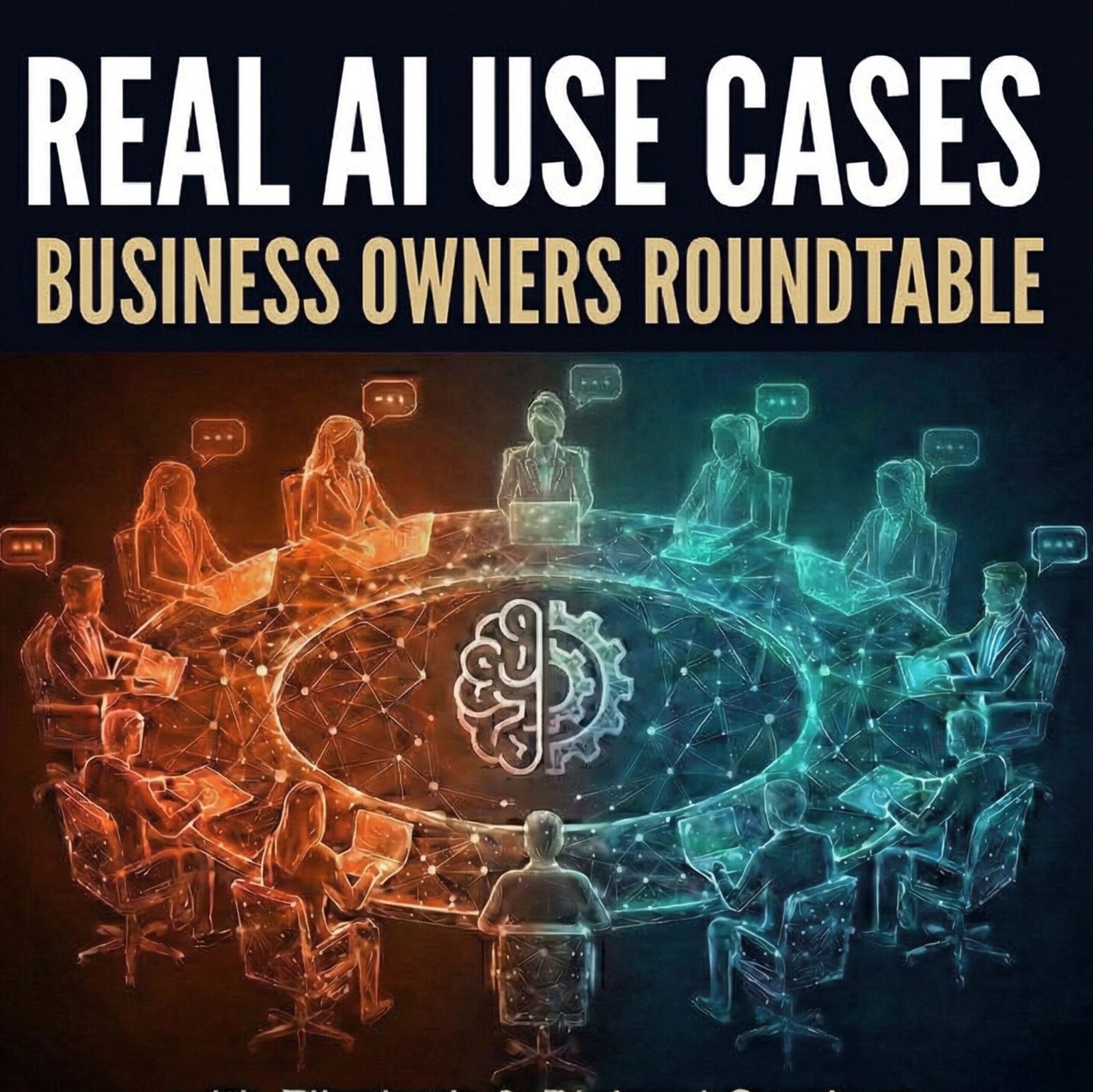
Does AI Kill Creativity? Real Talk with Romaine Waite & Business Owners Using AI Today
11 min · July 28, 2026
A bagel maker, a software developer, and two guests on machine learning that predicts bakes, AI as a research assistant, AI slop, and whether AI enhances or dampens creativity.
Key Takeaways
- Romaine Waite uses AI to synthesize information quickly, understand concepts, and decide whether something is worth pursuing, though he feels he should be using it more.
- Jeff Perera says his bagel business built a tech stack for its kitchen display systems and point of sale, using machine learning to predict bakes and see demand before it arises so bagels come out of the oven hot just as customers arrive.
- Deon Hargrove uses AI as a research assistant for data points and marketing help, and tells it to provide sources for each claim so he can fact check it, forcing it to justify its information.
- Richard Gearhart asks whether AI enhances or dampens creativity. Researching with AI keeps his brain asking follow-up questions, but AI-written radio copy is less vibrant than writing it himself, so it may do both at once.
- Elizabeth Gearhart is pivoting her studio from podcast creation toward video content, using AI to analyze what small businesses need for marketing, since video has risen to the top.
- Jeff says AI is a tool that is only as good as the user, and Deon says that because AI uses data it was trained on, using it sparingly to help with prompts and scripts enhances work, while asking it to write the whole script does not.
- Richard warns against dependence, noting interns who read summaries instead of cases lose depth, and Elizabeth says AI can help you start but not finish, since AI slop uses phrases like deep dive and delve that readers sense subconsciously.
Main Topics
Hear how machine learning predicts bagel bakes and how AI works as a research assistant that must cite sources.
Weigh whether AI enhances or dampens creativity, and why AI slop all starts to sound the same.
Learn why guests treat AI as a tool that is only as good as its user and caution against dependence.
Featured Guests
Meet the Hosts

Elizabeth Gearhart, Ph.D. is the host of Real AI Use Cases: Business Owners Roundtable, where she explores how businesses are actually putting AI to work. She is also CMO of Gearhart Law and co-host of the nationally syndicated Passage to Profit radio show and podcast.

Richard Gearhart, Esq. is co-host of Real AI Use Cases: Business Owners Roundtable and founder of Gearhart Law, a full-service intellectual property law firm. A longtime podcaster, he hosts Intellectual Property News and is the host of the nationally syndicated Passage to Profit radio show and podcast.
The roundtable’s through-line: AI is a tool you should learn to use, but only as good as the person using it, and it can help you start but not finish.
Episode Summary
Elizabeth and Richard Gearhart ask each guest for one way they use AI. Romaine Waite synthesizes information to grasp concepts quickly, Jeff Perera uses machine learning to predict bagel bakes, and Deon Hargrove uses AI as a research assistant that must cite its sources. Richard asks whether AI enhances or dampens creativity, and Elizabeth describes pivoting her studio toward video with help from AI research.
The conversation turns to creativity and dependence: Deon says AI uses data it was trained on, so use it sparingly, Richard warns that interns who read only summaries lose depth, and Elizabeth says AI slop makes everything sound the same. The group agrees AI is a tool that is here to stay and worth learning to use.
Frequently Asked Questions
How can machine learning help a bagel business?
How can you make AI research more reliable?
Does AI enhance or dampen creativity?
What is AI slop and how can you avoid it?
Why should you not become dependent on AI?
How is AI changing the Gear Media Studios business?
Episode Transcript
View Full Transcript
This is Real AI Use Cases, Business Owners Roundtable, with hosts Elizabeth Gearhart, podcast consultant, marketing expert and PhD researcher using AI every day, and Richard Gearhart, entrepreneur, seasoned business owner and intellectual property attorney specializing in innovation. Here’s how real companies are using AI right now.
So now it’s time for Real AI Use Cases, Business Owners Roundtable. I’m going to ask each of our guests one way they’re using AI, and they each get one quick answer, and then we’re going to go around and talk about AI and other ways that we may be using it and why we love it and why we hate it and maybe why we don’t use it. I am going to start with you, Romaine Waite. What is one way that you’re using AI right now?
How I’m using it, I don’t know if I use it enough right now. I feel like I should be using it more. But I think one of the quick ways is just to synthesize information, to understand maybe concepts fairly quickly and grasp if it’s something I want to pursue or not.
That’s a great way to use it. Okay, now we’ll go to Jeff Perera with Jeff’s Bagel Run. Jeff, what’s one way you’re using AI in your business right now?
So we use AI in our daily baking process. We built a full tech stack to manage our kitchen display systems and our POS. We use an old version of AI, something called machine learning. It’s been around for years. But it does create a beautiful process that algorithmically allows us to predict bakes, to see the need for products before they arise, so we can be just in time with our bagels. They come out of the oven hot right when the customers are there.
That’s really cool. Nobody’s said that one before. Okay.
Well, I think he’s the first bagel maker we’ve had.
Yeah, they’ve been around forever.
It’s a few hundred calories. Plain bagels have 13 grams of protein, only five ingredients, no preservatives. I think that sounds pretty good. We’re in a pretty good spot.
All right. So Deon Hargrove with SmartInvestorsApp.com. I imagine your whole life is AI practically, if you’re doing an app, right?
No. I try not to be overly reliant on AI, but I do use it as a research assistant. Whenever I need data points or help with marketing, I will ask AI a question and then I will tell it, provide sources for each of your claims so I can fact check it. Because as we all know, AI is not 100% reliable. So I force it to justify whatever information is given to me.
That’s a good idea. I do that. I check different sources, but you really have to. I agree. So, Richard Gearhart with Gearhart Law, what’s one way you’re using AI right now?
I’m going to take a little bit of a different tack this week, and I’m going to say, does AI enhance creativity or does it dampen it? Because I’ll tell you, when I am in the middle of trying to research something or figure out a problem and I’m using AI, my brain’s going, I’m asking all these questions, I’m following up on all the answers. I feel like I’m learning a lot and I’m getting closer to a creative solution. On the other hand, if you use AI, for example, to write your copy for your radio show, it’s not as vibrant, I think, as if you do it yourself. So on the one hand, AI is enhancing. On the other hand, it can be dampening, and maybe even do both at the same time. I don’t know. But I’ve just really been thinking about that lately.
That’s a good thought. Yeah, humans definitely have to intersperse. So for me, Elizabeth Gearhart with Gear Media Studios, I’m thinking of doing a bit of a pivot with my business, because I started the studio as a podcasting studio, helping people start podcasts. But it’s really hard to get people to do it, because it’s so much commitment, and they really don’t know what’s going to come out the end of it. It’s a lot of work, and most people don’t know how to do it. So I’ve always researched constantly with AI, like, what do small businesses need to do right now for marketing? And the answer changes all the time, but video has risen to the top now. So I’m repurposing and switching more toward video content creation instead of podcast creation. I’ve been using AI to really analyze that and see what is a good path for me to take, and really, with all the things I do, how can I make some money?
Always the big question in media. It’s fun, it’s cool, but does it pay the bills? That’s always the challenging part.
I think Romaine said something great earlier where he talked about attention, and I think that the world’s attention is in a five-inch screen in their hand. So if it’s video, and it could be a podcast that turns into video, if you’re clipping it and catching sound bites of an interview, it could be a great way to grab the attention of someone. And I think that’s just where we live. AI does facilitate a lot of that work that maybe someone didn’t previously have a skill set for, and it can help them edit a video or create captions. There are just some people who don’t have the skill set. If they tap into AI and they’re willing to ask those questions and learn, ultimately it’s a tool and it’s only as good as the user. I’m not a carpenter. If you put a saw in my hand, I’m not going to build you something. So Deon, as an engineer and a software developer using AI to help him along the way, probably 10x’s his productivity. And so I think if we look at it as a tool, it’s really beneficial for the world ahead of us. If we look at it as something scary, then that’s how we’ll perceive it.
And I want to piggyback off what Richard asked about, does AI enhance or dampen creativity? With anything, it comes down to moderation. AI does not necessarily create anything new. It uses data that already exists that it’s been trained on. So if you use it in a small amount to help you with, say, writing your prompts and your scripts, using it properly, it can enhance it. But if you just say, Hey, write this script for me, it’s not going to be as good as if you had done it. So you’re just going to have to use it sparingly.
It’s a very linear thinker. I was asking it, I’m going to do a new podcast, I think maybe with somebody, and I was asking it for podcast names, like, what would be a really good name for this podcast? I said a really good name, catchy. And it’s giving me these names and I’m like, is this name taken? And it’s like, well, yeah, this name is taken.
Not a good look for the wife of a law firm owner that specializes in intellectual property.
It was just so funny. It’s just a very linear thinker. It can’t think like we as humans would, like, well, it’s a good name because it’s not taken yet. But I use it for almost everything these days.
I think, to Deon’s point, you can’t become dependent on it.
No, you can’t.
I mean, we have interns that work with us and you ask them to do research and everything they do is on ChatGPT. They don’t necessarily read the cases. They don’t read what the court said. They read summaries. And so you lose something. If you take that shortcut, you get through it quicker, but then you don’t develop the depth that you probably should develop if you’re going to be a good attorney. It’s a double-edged sword. The thing is that people in our generation have already done all that work. So we can look at an AI output and say, that’s a hallucination. But if you haven’t done the background work, how do you know?
I used it to get started, but Richard and I were talking this morning about how with our YouTube videos, we can come up with better titles than AI can.
Or at least we think we can. But it’s kind of true. Sometimes it comes up with better titles, so it’s kind of good to check. But other times,
But the fear people have, especially in marketing, which I do, is that everything’s going to start to sound the same. And it does. It all sounds the same. And I’m giving a presentation. I did a slide on AI slop, and I don’t know, have you all heard the term AI slop?
Yeah.
I asked it to define AI slop. I work with Gemini and Claude and ChatGPT, and Gemini did this horrific graphic. It had so much going on in it, like your brain could not process it. And another one said there are actual phrases like deep dive and let’s delve into this, and then it uses other phrases to try to sound smart. So if you see stuff that’s written like that, your brain subconsciously kind of knows that it’s AI. And so I think you can use it to start, but you can’t use it to finish.
If I’m in a bad mood, I’ll ask ChatGPT, what do you think of me? And it’ll come back and say, oh wow, you’re just like the most amazing person ever.
Well, well,
I’m so glad you asked, Richard.
I had a situation where I was kind of annoyed with somebody and I said, they did this. And it came back and said, well, you’re absolutely right.
So,
They did not treat you well. So anyway, well, thank you for those enlightened uses. It’s here to stay, as Jeff said. It’s a tool.
Yeah.
And it’s a tool that you should probably learn how to use.
You have been listening to Real AI Use Cases, Business Owners Roundtable. We hope you found this valuable. Join us again for more stories, because the future of business is driven by AI. This podcast was recorded at the iHeart Studios in Manhattan as part of the Passage to Profit Radio Show.
Keep exploring the show
Hear how more business owners are putting AI to work in their day-to-day.