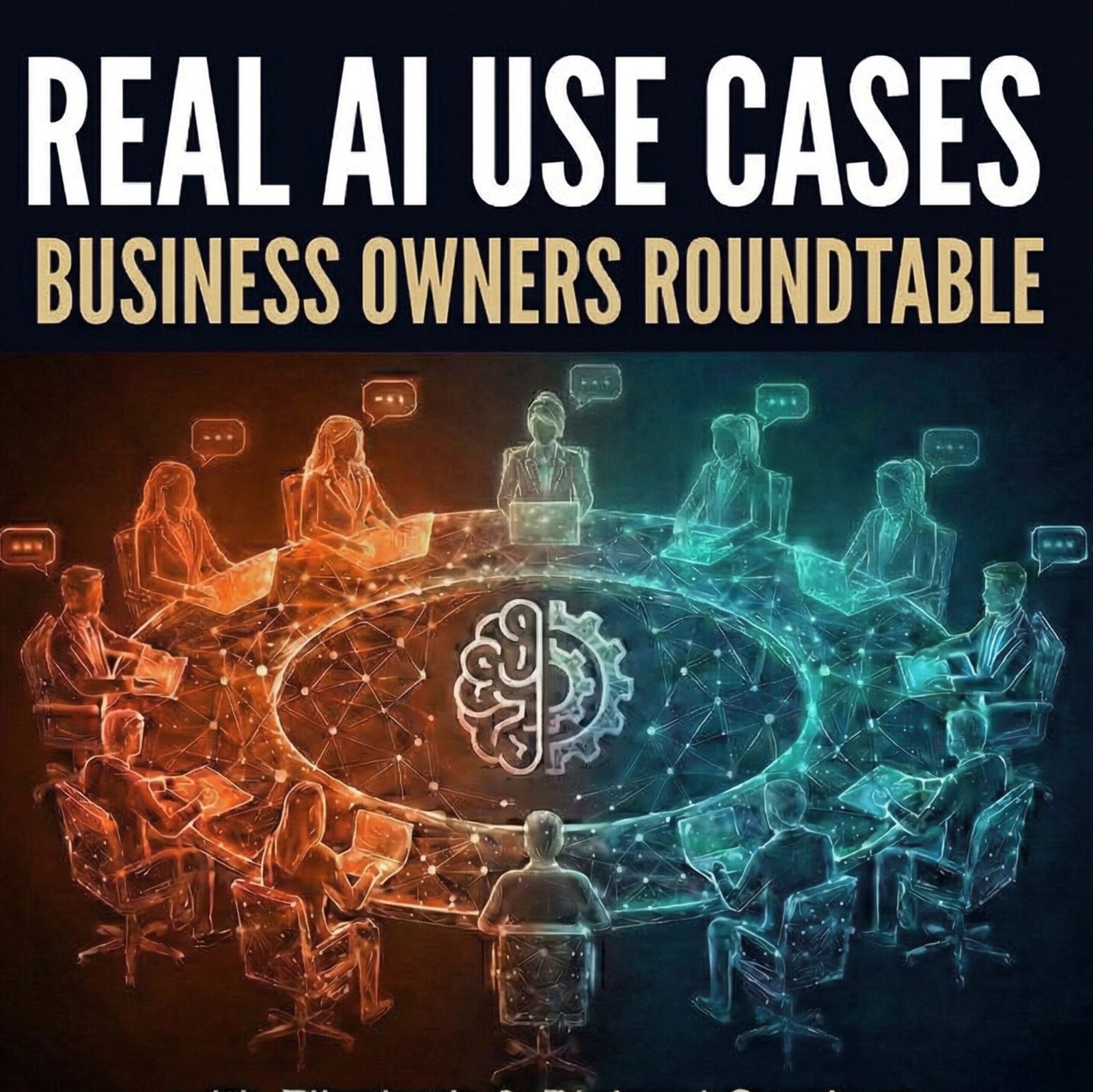
Real Business Owners Reveal How They Actually Use It, and What Scares Them
13 min · June 5, 2026
An etiquette expert, a business strategist, a skincare educator, and the hosts on AI backdrops, dictated presentations, video clones, workplace prompts, and AI-perfected images.
Key Takeaways
- Thomas Farley uses Midjourney to create green-screen backdrops, such as the slopes of Greenland or an auditorium in Los Angeles, for his weekly Mr. Manners Mondays segment, images he says he could not find on any stock image website.
- Lauren Paxton dictates everything she plans to say for a presentation, puts it through her AI system, and gets back a PowerPoint with worksheets, prefab designs, and agendas, so she spends her time on the work she does well and lets AI do the rest.
- Eva Kerschbaumer was nervous that AI would replace her, but now uses it as a tool: to talk to a younger audience as an educator, to match skin to foundations, and with diagnostic apps that let her send a photo of something suspicious to a dermatologist.
- Richard Gearhart says he has been following a Federal Trade Commission case against Amazon over AI-controlled pricing, in which prices rise and fall with competitors’ prices, and he worries that consumers and small businesses lose out.
- Elizabeth Gearhart plans to make a HeyGen video clone of herself for a tip-a-day series of YouTube Shorts. Richard asks whether viewers want a clone, saying people want to know who they will be dealing with.
- Thomas warns that AI tools mandated at work learn how you do your job, so your prompts can become company-owned content, and Richard adds that techniques recorded in a company system might be claimed as company trade secrets if you move to a new job.
- Lauren invested in a closed, high-encryption system so everything she puts into AI stays local, and Elizabeth notes you can run an LLM on your own hard drive. Eva says AI makes images too perfect, and Elizabeth thinks people may swing back toward seeing each other in person.
Main Topics
See how AI builds green-screen backdrops, turns dictation into presentations, and helps in skincare education.
Weigh AI video clones against authenticity, and who owns the prompts you write on a work computer.
Hear about keeping AI local and why AI-perfected images worry a skincare educator.
Featured Guests
Meet the Hosts

Elizabeth Gearhart, Ph.D. is the host of Real AI Use Cases: Business Owners Roundtable, where she explores how businesses are actually putting AI to work. She is also CMO of Gearhart Law and co-host of the nationally syndicated Passage to Profit radio show and podcast.

Richard Gearhart, Esq. is co-host of Real AI Use Cases: Business Owners Roundtable and founder of Gearhart Law, a full-service intellectual property law firm. A longtime podcaster, he hosts Intellectual Property News and is the host of the nationally syndicated Passage to Profit radio show and podcast.
The roundtable’s through-line: AI is a powerful creative and time-saving tool, but protect your prompts, your privacy, and your authenticity.
Episode Summary
Elizabeth and Richard Gearhart ask each guest for one favorite way they use AI. Thomas Farley, known for Mr. Manners Mondays, builds Midjourney backdrops for his green-screen segments; Lauren Paxton turns dictation into PowerPoints, worksheets, and agendas; and Eva Kerschbaumer uses AI for education, foundation matching, and skin diagnostics. Richard raises an FTC case over Amazon’s AI pricing, and Elizabeth describes her plan for a HeyGen video clone.
The conversation turns to worries: AI clones that may replace real presence, workplace AI that records your prompts and process as company property, the risk that trade secrets are claimed by an employer, and AI images so flawless that young people chase impossible standards. Lauren keeps her AI local, and the group closes on the idea that people may swing back toward in-person authenticity.
Frequently Asked Questions
How can AI create backdrops for video?
How can AI turn dictation into a presentation?
How can AI help a skincare professional?
Can your prompts at work become company property?
How can you keep your AI data private?
Why are AI-perfected images a concern?
Episode Transcript
View Full Transcript
This is Real AI Use Cases, Business Owners Roundtable, with hosts Elizabeth Gearhart, podcast consultant, marketing expert and PhD researcher using AI every day, and Richard Gearhart, entrepreneur, seasoned business owner and intellectual property attorney specializing in innovation. Here’s how real companies are using AI right now.
Now it is time for Real AI Use Cases. I’m going to ask everybody here for one really favorite way they’re using AI, and then after everybody says one way, we’re going to go around and just talk about all the different ways we’re using AI. Because if somebody’s using it one way, they’re using it a million ways, right? So I’m going to start with Thomas Farley. What is one really cool way you’re using AI?
I do a weekly segment called Mr. Manners Mondays. And I need a backdrop, I’m doing a green screen, and I need a backdrop that’s perfectly synchronized with what my content is going to be. I use Midjourney to create an image, whether it’s the slopes of Greenland, whether it’s an auditorium in Los Angeles. These are images I could not find on any stock image website, but my imagination is limitless on these things, and it helps my audience visualize. And I’m literally in front of a green vinyl tablecloth that’s swapped out with an image, a green screen setting on my Zoom platform. And so I use AI to create those fantastical images that are behind me in my segments.
That’s great. A great way. Lauren Paxton, what’s one way that you’re using AI?
I really use AI to make my business, my software, work for me. For me, it’s a bridge to use solutions that I wouldn’t use on my own. So, for example, I love to dictate and process externally. If I’m preparing for a presentation or a program, I’ll dictate and spell out everything I’m planning to say. I’ll put it through my AI system and shoot out a PowerPoint with worksheets and prefab designs and agendas. So I’m just spending the time doing the work I do well, and I let AI do the rest.
Well, that’s really smart that you’re doing that, because it gets to know your voice, then you’re feeding it your content. That’s
Right.
Yes. Eva Kerschbaumer, what’s one way you’re using AI?
Thank you for asking this question. I was actually very nervous when this whole thing was coming out, and I thought, well, I’m not going to be needed. Are they going to do facials without me? Are they just going to tell advice? And I use it as a tool. I’m an educator also, so it helps with the younger audience, to talk to them in a different way. And also matching skin to foundations. And there’s something called a diagnostic. When something looks suspicious on the skin, there are some apps where you can take a picture and send it to your dermatologist and look at it together. So we’re not worried about it. Hey, is this something that I need to be calling 911 for, or is it going to be okay to wait for my next appointment? And that’s why I love it. I use it all the time.
That’s a great idea. Richard Gearhart, what’s one way that you’re using AI?
I have been following the news a bit lately, and there’s, I guess, a case that’s coming up for trial at the Federal Trade Commission against Amazon. They’re using AI to control pricing, and the net result of this seems to be that prices are going up rather than maintaining this competitive market that we all hoped would be there. And what they’re doing is they’re going out and checking on competitive pricing, and any time a competitor lowers their price, they lower the price that the consumer sees, or if the competitor raises the price, they raise the price. And so they assume that because there are like 200 million people using Amazon, they’re just going to order from Amazon instead of going to another competitor. And this really has a negative impact on small businesses, small startups, because they can’t compete with the Amazon experience. And it’s really difficult. So it’s AI, and it’s connected to me because I use Amazon, and I just hope that the Federal Trade Commission does something to fix this, because I really do feel like consumers are losing out because of these tactics, and it’s all because of AI.
Yes. And me, Elizabeth Gearhart. I’ve been using it for research. I’m researching something I really want to try. I don’t know if you guys have heard of HeyGen, where you can make a video clone of yourself. I have a studio, Gear Media Studios, so I have the cameras and mics, and as I said, Maggie’s joined me in the studio. We’re going to be talking, and what you do is you do a video of yourself, but you try to capture all your facial expressions. So you do want to have a conversation with somebody, and then we can filter her out with our editing software. We’re going to do that and then edit it, and then put it into HeyGen, and then hopefully make a pretty decent video clone of me. And then what am I going to do with that?
We don’t know. Can we really be blessed with two Elizabeths?
That’s not what Andy at the law firm said. He said, the world doesn’t want two of you. So I wasn’t very good.
Yeah, that was my good.
But no, I’m going to do short videos for YouTube Shorts and I’m going to do a tip a day. And what they’re saying now is you can do that, but you have to intersperse some that aren’t your clone doing your shorts for your media. But what you do is you type in what you want it to say, it can be like 30 seconds, I think. And then it’s just like you talk. And I want to learn this now, because once it gets better, I’m going to send it to the Gearhart Law meetings and have it sit in for me.
Lucky us.
Just kidding.
Nobody can replace you, dear.
Just kidding.
But seriously, is this the path we want to go down? Because I feel like when people go to YouTube, they want to hear the person that they’re going to be dealing with. And I agree it’s a marketing tactic, but I want people to know who I am. And how closely is the AI clone going to replicate that?
Well, we’ll find out. And I mean, there are two types of clones, right? There’s the one like Lauren’s starting to do, where you put all your content in and it clones your thoughts. There are people that are doing that right now.
But this is going to clone your face,
Your voice, your visage, and your mannerisms
and all of that. Yeah.
Yeah. And apparently, according to HeyGen, the software’s very carefully guarded so that somebody can’t
Somebody can’t use it for inappropriate reasons. Yeah. That’s another risk, right?
Yeah. So what are your guys’ thoughts on this?
You know, it concerns me a little bit. I think we’re living in an age where AI has gotten so close to reality, it’s very difficult to determine. It used to be, don’t believe it unless you see it. Well, now even seeing it, unless you’re seeing it with your own eyes in person, can you truly believe it? And I find that frightening. Now, this use case sounds fun, but in a way I almost feel like we’re training our own replacements. And one thing I’ve been reading about quite a bit is that for corporate employees who are mandated to be using, whether it’s Copilot or Gemini at the office, those same learning models are actually learning you and learning how you do your job. So ultimately that becomes the IP. Your interactions with the AI at the corporation become the owned content of the corporation. So when they need to either train your replacement or completely eliminate your job, they’ve got all of your prompts, your thought process, your hierarchies. So what I’ve read is, if you must use AI at work, use it on your own personal devices and then input whatever answers, but don’t include your prompts on your work desktop station, because you’re basically training your replacements.
Well, and the prompts are so important. I feel like that’s where the human ingenuity comes in. With my prompts sometimes, I’m asking questions that I know other people aren’t asking, and I’m asking them a different way, and that’s really your main intellectual property, right? Or the prompts you come up with.
Unless the company owns it and takes it and says, thanks, we don’t need you anymore.
Yeah. And it goes beyond that. What if you look for another job and you have certain techniques or processes that you’ve developed and you want to bring to a different company? If it’s all recorded in this company system, then they might make a claim that those are company trade secrets.
That’s right.
And you can’t act the way that you would normally act in a new job.
That’s right. I hadn’t even thought of that, Thomas.
I mean, that’s really frightening. That is really scary.
So, Lauren, thoughts?
Yeah, so I looked at this question closely before I started using it, and I actually invested in a closed-end, high-encryption system for myself, because I want to make sure everything I put in my AI stays local with me and no one else has access to it. It’s not even being used, anonymously, to train the AI that I’m using. So everything I have, I at least have in theory some sort of ring fence around, because I don’t know the extent of what can be done.
Well, yeah. Richard was watching a video and they talked about OpenClaw. Have you heard of OpenClaw? It’s an AI agent that reads everything on your computer. And I was like, oh my gosh. And then it goes out to the LLMs online and shares your information. But you can get, I think what you’re talking about is similar, an LLM that lives on the hard drive of your computer.
Yep.
That is not on the internet.
Yep.
Right?
Yep.
Yeah.
Yeah.
So what about you, Eva? Thoughts?
So for me, I do love it for education reasons, but I am concerned because it’s also too perfect. So if we think about pictures, for example, our youth and women my age, imperfections are there. It’s not like your anti-aging is longevity. You are beautiful who you are, but when these AI pictures show skin flawless, our youth is thinking this is what they’re supposed to look like. They’re over-washing, they’re overusing chemicals on their skin. If you look at videos, what a young 12-year-old is doing right now, how many steps they’re doing in a skincare routine? It’s frightening.
That’s awful.
It is. And so yes, it is for me, like I said, education-wise great. I use it. But it’s also extremely scary for me.
Well, it’s a really interesting point, because television set a standard for us. Before television, things were normal, I guess. But then when TV came into play, everybody started thinking that people acted and lived in houses like on TV.
Correct.
And that sort of set a standard for what people considered to be normal. And now with AI, that standard’s getting even higher, when you have all of these software algorithms perfecting everything. I think that’s going to be tough to live in this world. People are only going to want the perfection. So it’s just a very interesting issue. And I
I don’t know, I think it might be a pendulum swing. It might be, like Thomas was alluding to, that people are just going to want to go see each other in person.
Eventually we’re going to give up, let AI run the world, and you hang out and you have karma, you know?
Yes. And they’ll be like, oh, you have a zit on your nose, you’re a real person.
Thank God I found somebody with a real blemish.
Well, this has been Real AI Use Cases.
Keep exploring the show
Hear how more business owners are putting AI to work in their day-to-day.