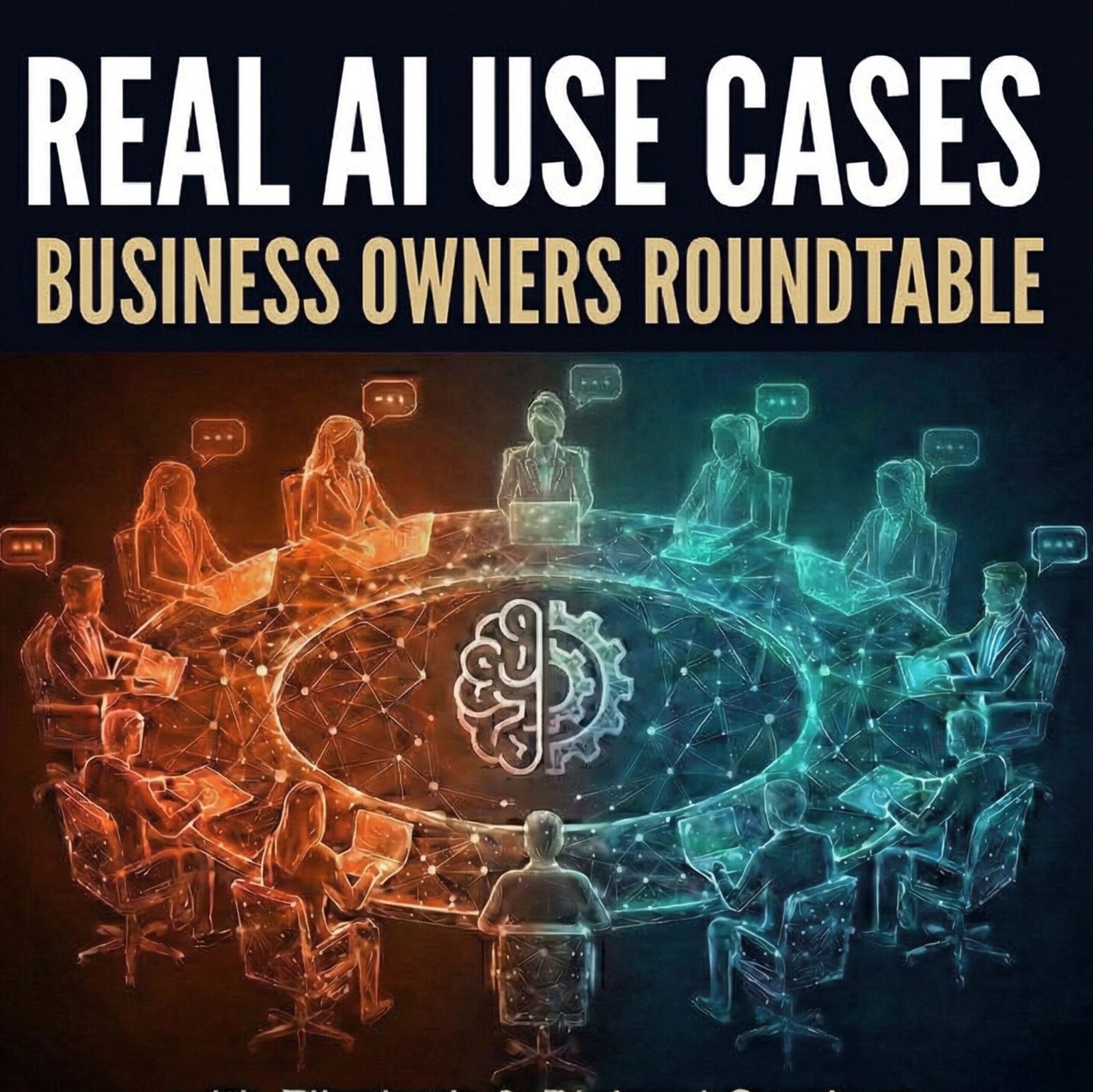
How AI Agents Transform Sales, Training and Business Growth
35 min · October 13, 2026
A sales and AI platform leader explains how agents, role-play practice and a clear ‘why’ can help one person do the work of many.
Key Takeaways
- AI agents that connect email and your CRM can learn from conversations and help write better emails at the right time.
- Without a strategic ‘why’, AI becomes a solution in search of a problem, and teams may fear being pushed out.
- Think of your work as a pie chart: automate the roughly 60 percent machines do well and double down on the uniquely human 40 percent.
- Practice environments let people rehearse difficult conversations at any hour, with objective feedback and coaching.
- Native AI companies have an advantage, but you can retrofit by testing new processes in a sandbox before replacing the old ones.
- AI still misses the big picture: it took a human to ask whether staff time was counted in a software savings estimate.
- Measure pilots with objective metrics, such as onboarding speed, deal cycle and average deal size.
Main Topics
How AI agents connect conversations to a CRM to improve outreach.
Why asking ‘why are we doing this?’ leads to incremental or transformational gains.
How AI role-play helps people practice the rapport, trust and judgment machines cannot replace.
Featured Guests
Meet the Hosts

Elizabeth Gearhart, Ph.D. is the host of Real AI Use Cases: Business Owners Roundtable, where she explores how businesses are actually putting AI to work. She is also CMO of Gearhart Law and co-host of the nationally syndicated Passage to Profit radio show and podcast.

Richard Gearhart, Esq. is co-host of Real AI Use Cases: Business Owners Roundtable and founder of Gearhart Law, a full-service intellectual property law firm. A longtime podcaster, he hosts Intellectual Property News and is the host of the nationally syndicated Passage to Profit radio show and podcast.
Elizabeth and Richard share how they use Perplexity for outreach lists, Copilot for software decisions and an AI agent that built a website in five minutes.
Episode Summary
Paul Burani of Atlas Primer joins Elizabeth and Richard Gearhart to explain how AI agents connect conversations with CRM data, why entrepreneurs can do the work of many people, and why leaders should start with a clear reason for adopting AI. The hosts share their own uses, including building outreach lists with Perplexity.
Paul describes his platform’s AI role-play scenarios for practicing difficult conversations and the strategy behind adopting AI. He also covers pilots, measurement, keeping data secure and a Nordic travel company example where shared data revealed a product launch problem.
Frequently Asked Questions
How can AI agents improve a CRM?
What does a strategic AI plan look like?
What is the 60/40 model for work?
How does an AI role-play practice platform work?
Should startups design processes around AI?
Can AI replace a full workforce?
Episode Transcript
View Full Transcript
Welcome to Real AI Use Cases: Business Owners Roundtable. I’m Elizabeth Gearhart.
And I’m Richard Gearhart.
We’re here with Paul Burani of Atlas Primer. Paul, what is one way you are using AI in your business today?
To pick just one to share with you, that’s a creative decision. But one thing I’m very interested in is how AI connects disparate resources and technologies and makes each better. We all write emails, we all connect with customers, partners and stakeholders, and a lot of us use a CRM to manage our relationships. What I quite like is using AI agents to connect the two and achieve a one-plus-one-equals-three effect, where the intelligence absorbed from conversations, what we learn from dialogue with customers or from managing relationships with new prospects, actually trains the CRM to better understand how to communicate, how to write better emails and when to write them so they’re most likely to be read. We’re optimizing for attention. I love having agents where I can ask questions in plain English, like what’s the right angle to use with somebody in the B2B SaaS category about a trend I’m seeing, and how could we use that to make a case for our product? The only limit there is creativity.
It’s funny you say agents, because a few months ago it was, agents are coming, and people didn’t really know what they were. Now they’re here, and I see the different LLMs going into agent mode sometimes when I query them. Richard Gearhart with Gearhart Law, what is one way you’re using AI?
Just to continue on Paul’s theme about marketing and networking, there are a lot of ways to reach out to potential business partners using AI, to find people who would be a good fit for our law firm and come up with creative ways to contact them. That’s the basis of every attorney-client relationship. The relationship has to start somewhere, and there has to be interest on both sides. One of the great things AI can do is help us position ourselves so the potential client sees all the things we can offer and ways to improve their business.
I’m Elizabeth Gearhart with Gear Media Studios. In conjunction with what Richard just said, Paul, you were talking about the CRM. Richard asked me, can you have one of the LLMs identify this subset of business people for me and get their email addresses? I asked Perplexity, and it said, I have agents working on it, and when they come back with their data, I’ll give you your answer. It gave me a spreadsheet of exactly what I asked for, and then it said, what are you going to do with it, because you don’t want to spam people. I said I use Zoho, and Zoho is very careful about unsubscribes. So it said, okay, here, I’ll give it to you in a form you can upload to Zoho Campaigns.
After we received the list, I said maybe the first step is to reach out to these people on LinkedIn and establish a connection, and then send them a newsletter with content geared toward their offering. It doesn’t have to be a huge 5,000-person email list. We’re looking at outreach to maybe 200 people. By finding the right fit right away, we don’t have to worry about spamming, and we can go right to the people we think would be a good fit for us and who we’d be a good fit for. So it has a lot of strengths.
Now let’s get into the guts of the conversation. Paul, what do you think of AI? You’ve been in business for 20 years, in sales and marketing. Did you see this coming or did it hit you like a ton of bricks? The people using it are making strides, and the people not using it are having a hard time right now.
Good question. Let’s keep in mind that artificial intelligence was really born somewhere in the middle of the 20th century. In the same way our Department of Defense spawned the internet when nobody was paying attention, and then in the ‘90s we started getting email addresses and all of a sudden we were power users, the same thing is happening with AI. When I was a sophomore in high school in the mid-’90s, I wrote a paper on the chemistry applications for artificial intelligence. I picked the topic thinking it would be cool, and then I thought, oh my God, how am I going to connect this to chemistry? I got a B, so I did a good enough job. In hindsight, what I was writing about was very esoteric. In 2022, the shot heard round the world was OpenAI releasing ChatGPT to the general public. You could call it a killer app, to use an overused term. It wasn’t a technological breakthrough so much as a user experience breakthrough. It taught the layperson, hey, I can use this very powerful technology myself.
What people are mainly doing with ChatGPT, Perplexity, Claude and Gemini is largely what they’ve been doing with search engines, but there’s an evolution. We’re becoming more sophisticated about what we ask, how we follow up with clarifying questions and how we embellish our prompts. Agents are a quantum leap, because now we’re effectively training the AI to go out and ask the questions and clarify the prompts and do all of that by itself without us having to put that energy in. I think that’s what’s really exciting: the force multiplier for our creative and operational energy. As entrepreneurs, we see it very acutely. In an enterprise environment, we have to jump through hoops, get approvals and be careful about what we share, so the power is capped, limited and diluted in certain ways. As entrepreneurs, we are truly the frontier people, like Lewis and Clark navigating the river and seeing what’s around the bend. We’re finding that one person can do the work of 10 people, or 100 people, and you have amazing companies doing incredible things incredibly quickly with very lean business models. That changes the whole economics of how you found a company and compete nowadays, and that’s where a lot of the transformative impact is happening.
I agree. Over this past year I’ve seen a cottage industry explode of people willing to help you implement AI in your company and write AI agents for you. When you have a hammer, everything is a nail. Some people are overenthusiastic and not strategically deploying AI in their businesses, and that’s why they’re not seeing the ROI they hoped for. You have to take a critical look. Have you found that to be true for yourself?
Absolutely. As career salespeople, we have another way of saying it: a lot of misguided sales and business development efforts look like a solution in search of a problem. Are you here just to sell something, or are you truly in a fix-it mindset? The best example I can give you is in my business today with Atlas Primer. Our conversations go much further when we’re talking to a leadership team that is thinking long-term about AI. They are thoughtfully building their AI stack rather than chasing shiny objects, and they’re not using point-shaving as the guiding ethos. By that I mean onboarding AI just to trim a little margin here and a little cost there. Ultimately everybody under the leadership team on that org chart starts thinking, it’s only a matter of time before I’m on the outside looking in. We’re looking for organizations that, to your point, Elizabeth, are thinking strategically and saying, we want to use this technology to further entrench our people in the business. People are incredibly valuable and important. We’re not onboarding this technology to make people irrelevant. It’s a choice we have to make, and we’re going to be on one side or the other.
Can you provide some examples of steps a forward-thinking management team would take versus the low-hanging-fruit approach? There’s nothing wrong with taking low-hanging fruit, but what would a strategic, long-term approach look like?
The first thing is to ask, what do we hope to achieve here? It’s amazing how often people don’t ask that question. Why are we doing this? Work on answering that with a committee, a word that’s sometimes overused, but it needs to be more than one person, because you need different points of view. Imagine getting your leadership team together and saying, there’s this new technology and there’s an opportunity cost to not using it, but we’re not going to deploy it just because our board, our customers or Wall Street says we need to. We’re going to do it because we see an opportunity, and if we don’t, we have an opportunity cost we’re not willing to absorb.
When you go through this process, are you visioning a new business model or how the business could operate in the future, or just making current systems more efficient? For a law firm, I could imagine people just calling in, telling us their legal issue and getting a complete solution in 30 seconds. That would be the most efficient way to deliver legal services, but it’s pie in the sky, maybe 30 years away. How do you manage what is possible versus what is likely? I always have ideas for things that are impossible.
That’s a healthy sign of your business and its fundamentals. I think the answer to your question is the result of the why exercise. If we know why, we’re intimately connecting not just our AI objectives but our business objectives. Why do we exist? Tell me more about what your law firm does uniquely well.
We’re an intellectual property law firm, so we protect ideas through legal means: patents, trademarks, copyrights and trade secrets. We help companies at early stages incubate and protect their initial ideas, and as they grow we help them manage a portfolio of intellectual property. We help them monetize the assets as they mature, and we defend and enforce those rights if necessary. That’s the spectrum we work with.
One of the strengths of Gearhart Law is that it’s an entrepreneurial law firm. Richard started it with zero clients in the attic of our house 20 years ago and has had all the ups and downs a business owner has. He has a unique perspective from having worked in corporate, on how intellectual property can affect the bottom line and where it fits into any business structure. Anybody can just get a patent, but how do they use it? He has a lot of background and can counsel people on that.
The reason I ask is that there’s a spectrum of growth or innovation coming out of this fundamental question, what can we do with AI? On one extreme there are incremental gains. They’re easy, low-hanging fruit at arm’s length, with limited upside. On the other side you have transformational gains. Asking why we’re using this technology might yield seminal concepts for real innovations, like a better client intake process or a shorter cycle to the outcome you want, or the ability to serve a segment of customers that previously weren’t profitable for you. Those are end games, and then you work backwards and ask how AI would allow us to achieve that. On the transformational side, and I’m doing a little speculative talk here, you work with early-stage founders who have exciting technology products and a lot of IP. They live and die by their ability to protect their turf, and you’re the best in the business at that. While you’re building these trusted relationships, what if you took what you’ve learned and transformed it into a risk mitigation mechanism that allowed you to make really smart investments in these companies at an early stage when the returns are potentially astronomical? A law firm would eventually use its expertise to become an investor. There might be regulatory guardrails, but that’s the how. The why would be that we believe in entrepreneurship as the backbone of the innovation economy and we have a head start because we know our business so well. That’s a real transformational aspect, and AI is where you leverage the intelligence you have, augment it with intelligence you don’t have, and fit it into a new business model.
That’s brilliant. Part of the process you work through with teams is how you tease all of these things out?
I should give a little context on what my company does with AI. Atlas Primer is a platform to maximize human potential in the age of AI. That sounds lofty, so let me qualify it. We have a problem in today’s workplace: AI seems to be coming for all of our jobs. Regardless of how you feel about that, everybody is still showing up to work, and we’re thinking differently about our work because it consists of many tasks that could be done better, faster, cheaper, or all of the above by AI. We’d be fools not to leverage that. If my work were a pie chart and I could take 60 percent of what I do and automate it at a fraction of the cost, then take the remaining 40 percent and be the best in the world at it, that’s the model for the new career path. Let the machines do what the machines do best, and double down on the things that are uniquely human: the ability to have meaningful conversations, build rapport and trust, exercise judgment and give people confidence in our wisdom. The bots are not replacing those.
I’ve spent my whole career in some part of the revenue organization, and everybody can intuitively understand that’s a great use case, because you live and die by your ability to influence others. Machines are not writing seven-figure checks to other machines. That still happens between people. As a salesperson, if I was making 200 cold calls or writing 200 cold emails a day, doing desk research or painstakingly putting notes into the CRM, those days are over, and now I’m spending time practicing. But we don’t have that muscle memory. The modern workplace doesn’t have a practice environment, an infrastructure where people can refine their human skills in a safe space without judgment or embarrassment, and that’s what Atlas Primer is building. We have a role-play app where you can define a specific persona. Say I work in a call center and my customer is a stranded traveler calling the airline, irate. I need to model that customer and all their nuances, and my goals are to de-escalate, make them feel heard, make them trust I’m here to solve their problem, and then solve it. I go through a role-play scenario, find out how I did, get real coaching and feedback. Did I use the right language to articulate our solution? Did I stay within compliance guardrails? Did I actively listen and play back the things they said that are at the core of the problem? We attach that to business outcomes. Nobody disputes that practice makes perfect, and in the age of AI you now have the ability to practice, as many times as you want, 24/7, at 3 AM when you’ve got insomnia, whatever it takes. You’re not stuck waiting for a coach to be in the room with you.
I love this. Less than a year ago, one of the first guests said he had a customer service company that recorded the phone calls and had AI analyze them and give feedback, which I thought was awesome. You’re one step beyond that. I do want to ask, Paul, should entrepreneurs starting new companies now design their processes around AI instead of retrofitting AI onto a process?
The devil’s in the details, and each process would need to go under the microscope. I do agree that native AI companies have an advantage. That’s why a lot of the small fries are doing real battle with their bigger competition these days. Retrofitting is tricky, but you can build solutions in a sandbox without undoing what exists today, build in a safe space and only replace it once it’s been stress tested. You don’t have to take over your whole business operating system at once. Of all the things you could improve with AI, look at the recruiting process, how we bring in new talent, and see if we can get some incremental gains there. Maybe there are a moonshot or two we want to try, get people bought in and bring them along slowly. Slow and steady wins the race.
It was interesting. We’re doing a software upgrade, and I went through the statement of work and put it into Copilot, the LLM we use for the law firm because it’s secure. I asked, based on all of these upgrades, how much money are we going to save if we make the investment? It came up with a number, and I asked, did you consider the staff time associated with implementing the software and not just the vendor cost? It went and came back. My point is that AI is not yet able to see the big picture. I would have thought that would have figured into the analysis, but it took somebody more familiar with how business operations run to notice and ask.
I want to relate a very recent AI experience that just ended today. I have a personal website, Elizabeth Gearhart PhD, where I post blogs about how I use AI. It’s built by an agent, and it’s amazing. I had to build my website, and it just did it. I didn’t have to do anything. It was amazing, in about five minutes. I thought, oh my gosh, these guys are really good. But then I tried to publish a new blog and it wouldn’t publish because of some really weird error. They sent me to a person online, and the person was able to figure out the problem and tell me how to fix it, and now it works again.
I guess the moral of the story is that we’re a long way from a completely humanless workforce. And the steps your company is taking are really important. I love the analogy of getting rid of the 60 percent that can be done with AI and focusing on the 40 percent, doing more of it. That’s what’s going to drive business growth.
And I love the role-playing, because I think it teaches people skills that we’ve lost.
How do you set up a program like that? I don’t know if this is proprietary, but what’s involved at a top level?
The product itself we license to our customers, but your implication is correct, Richard: a certain amount of programmatic support is needed. Typically there’s a program owner. If it’s an executive leadership application, it might be a chief of staff. You need an owner and a practitioner. It goes back to our earlier conversation about the why and the how. There’s a capability gap in some shape or form. They may ask us to help diagnose, refine and quantify it, but someone has a hunch that maybe we’re not so good on the phones, or maybe we’re not making the best use of trade shows and face-to-face relationships. The hypothesis helps structure a program to test it, and usually our customers start with an eight-week pilot. The most important thing is to measure it objectively. In a sales organization, we can look at the CRM: how quickly are new reps being onboarded, how long is the deal cycle, how big is the average deal size? Then you have an objective metric to say it improved or it didn’t, and you can back into the training intervention. If onboarding is taking too long, we can weave the onboarding materials into a scenario and say, you’ve gone through all these decks and sessions, now you’re going to pitch the AI, and until you score a 95 or better, you don’t go out in front of clients. Every single one is different.
Paul, we have a couple of super closers at the law firm, and Richard is one of them. He’s very good at converting leads into clients. How do we capture his special sauce, and where does it live? He could be training people, but he doesn’t have time. I’ve thought maybe we’d have an internal Gearhart Law LLM with a spot on sales calls. Where does that information live and how do people access it?
This is an open-door meeting, and I’d conduct it a little differently if it were closed-door. I’d ask, how is your sales intelligence documented today? What makes Richard good at closing, and how easily can we retrieve and codify that? If we can’t, it’s not the end of the world, we just have a little more work up front. Presumably there are notes in the CRM, maybe testimonials from satisfied clients, that start to draw correlations: the relationships that go well tend to have these hallmarks. It might be the way certain legal proceedings are handled, or the way clients were qualified in the first place. There are a million variables, but you want to arrive at a formula that says when we do this, it goes well, and when we do this, it doesn’t. Then at scenario creation you can say, here’s the fictitious person we’ll practice with, and we’ll drag and drop some documentation into the scenario as well. That becomes a starting point. The beauty of AI is that it learns dynamically. Richard can train it better just by showing up as himself, and every new rep that comes in, the system learns about their strengths and weaknesses and compensates if you want it to. If they really don’t understand how to close, we keep hammering away until we get it.
Where does that information live? Should we do an internal LLM in Claude, which we’ve been considering, and put that information there?
It would live within your instance of Atlas Primer. A lot of it is public domain. Whatever underlying LLM you use, most of the information is the same, whether you go from OpenAI to Anthropic to Google. It doesn’t get shared with our other customers and it’s not visible to the outside world. Every recording generates data, but the recording is discarded, which is really important because we take the security of this data very seriously. It becomes your own knowledge base. Data coming into Atlas Primer is contextual data that either makes scenario creation more efficient or more effective. Gong, for example, is a tool a lot of sales organizations use to record their phone calls. We have a connection to Gong where you flip a switch, and whenever you create a scenario it has up-to-the-minute intelligence on what happens on those calls, which makes scenarios quicker and more precise. The other way to look at it is data that comes out of Atlas Primer and informs other applications, like a CRM. Say a rep has to hit a million dollars by the end of the fiscal year and looks like they’re tracking. Are there other signals that suggest maybe they won’t? For public companies, forecasting with precision needs as much signal as you can get, so a connection to the CRM could add signals and raise or lower confidence that the person will hit their number.
Can you give us some examples of results companies have achieved, and the size of your clients?
We like to work with organizations of a certain size, because you need a critical mass of people using it to generate data you can compare and contrast. Typically they have a hundred, two hundred people or more, maybe a sales organization, recruiters or the executive team. It’s across industries, because the problems we’re solving are pretty universal. You see them in pharma, manufacturing, retail and media. For a success story, in the Nordic region we work with a pan-regional travel company that operates many brands, each with relevance in customers’ eyes for specific destinations and experiences. These teams have been working in silos. The intelligence gathered at one part of the process could be very useful later, but the systems haven’t been in place to transfer that knowledge, so they’re all fighting their own battles, the same ones, without the collective knowledge. Tribal knowledge is a real problem in any industry. By getting everybody onto the platform we saw certain patterns, and in one instance it raised a very sensitive topic with the leadership team: a product launch deemed to have been executed very well wasn’t performing well, because the team wasn’t universally bought into the value-based messaging. Imagine you launch a new product thinking everybody’s on board and half of them didn’t get it but went to market anyway. Big problem. They used the data to take corrective action at the enterprise level: each brand has autonomy, but there are a couple of things the holding company believes are more important, and supporting this product is one they lean into. We’re just rolling out 2.0, and it’s very promising.
I think the beauty of AI is it can take a ton of data that other programs couldn’t handle and get a cohesive result from it. It goes online and looks everywhere. It would have taken us weeks to dig that out, right? And we had different parameters it had to look at, and it was able to put them all together. What you’re doing sounds really powerful for businesses.
We certainly think so. Our job is to get others to come to the table with their problems and see a different way of doing it, so it’s a very collaborative process. We’re not a services organization, but we apply that soft touch. And yes, we use our own product, because anyone can get better with practice.
Excellent. Thank you very much, Paul Burani with Atlas Primer, and thank you, Richard Gearhart with Gearhart Law.
My pleasure.
I’m Elizabeth Gearhart with Gear Media Studios. We’ll see you next time.
Keep exploring the show
Hear how more business owners are putting AI to work in their day-to-day.