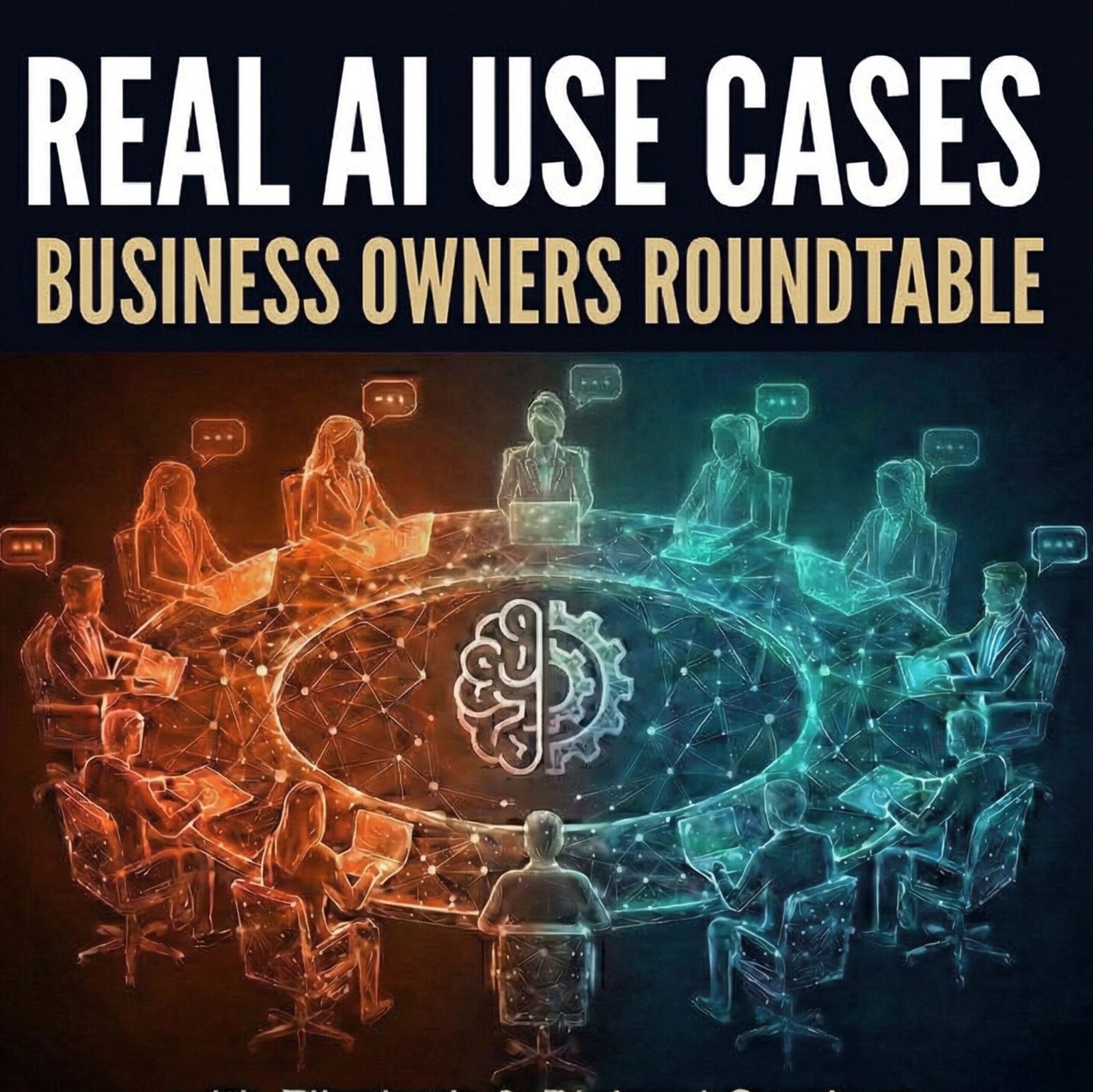
Episode 17 – AI Agents Speeding Up Business Tasks
14 min · May 15, 2026
Business owners on AI agents for staff, customer service tools, teaching yourself SEO, personal branding, longevity planning, and the limits of AI.
Key Takeaways
- Matt Ross is building an AI service tool for One River School of Art + Design members that answers basic questions right away, so members do not have to wait on voicemail, email, or a returned phone call.
- Eleanor Kubacki’s agency is adapting AI agents for all of its staff, and she says about 35% of the agency’s work is now being done by AI, which makes harnessing it responsibly a daily balancing act for a CEO.
- Antonia Tomao uses AI to learn: she taught herself SEO with ChatGPT by spending 48 to 72 hours going through each of her products, and she used it to fill out a tax certification and renew her real estate license.
- Elizabeth Gearhart had Google Gemini walk her through building the podcast website, then used ChatGPT to find what was wrong with it and fix it so it ranks higher on Google. Her takeaway: don’t rely on just one AI tool.
- Richard Gearhart is using AI to work through a complicated acquisition of another intellectual property practice, including different systems and attorney commission structures, and says it works best with a limited scope of information.
- Matt built a longevity plan in ChatGPT with a goal of living to 100, and Richard uses AI to track calories and macros and has lost about 30 pounds over the last couple of years.
- Know the limits: AI invites endless rabbit holes, and Eleanor found it got stuck on a custom greenhouse search until she found the smaller companies herself and uploaded that information.
Main Topics
See how Eleanor Kubacki’s agency is adapting AI agents for its staff and how Matt Ross is using AI to answer member questions.
Hear how Antonia Tomao taught herself SEO and more with ChatGPT instead of waiting to hire someone.
Understand why AI can send you down rabbit holes, get stuck, and still needs human judgment.
Featured Guests



Meet the Hosts

Elizabeth Gearhart, Ph.D. is the host of Real AI Use Cases: Business Owners Roundtable, where she explores how businesses are actually putting AI to work. She is also CMO of Gearhart Law and co-host of the nationally syndicated Passage to Profit radio show and podcast.

Richard Gearhart, Esq. is co-host of Real AI Use Cases: Business Owners Roundtable and founder of Gearhart Law, a full-service intellectual property law firm. A longtime podcaster, he hosts Intellectual Property News and is the host of the nationally syndicated Passage to Profit radio show and podcast.
The panel’s through-line: use AI to learn, to serve customers faster, and to move your team forward, while knowing where it gets stuck.
Episode Summary
Elizabeth and Richard Gearhart lead a roundtable on how business owners are putting AI to work. Matt Ross, founder of One River School of Art + Design, is building an AI service tool that answers basic member questions and has built a longevity plan in ChatGPT; Eleanor Kubacki, CEO at EFK Group, describes adapting AI agents for her agency’s staff; and Antonia Tomao, CEO and Founder of Antonia’s Promise, explains how she uses AI to learn, brand herself, and teach herself SEO.
The hosts share their own uses too: Richard works through an intellectual property practice acquisition and tracks his calories, and Elizabeth uses Google Gemini, ChatGPT, and the Manus AI agent for her website, YouTube thumbnails, and podcast covers. The group closes on the limits of AI, from endless rabbit holes to a custom greenhouse search where it got stuck, and why a human still has to steer.
Frequently Asked Questions
How can AI improve customer service for a small business?
How are AI agents being used inside an agency?
Can AI teach you skills like SEO?
Why use more than one AI tool?
What are the limits of AI?
How can AI help with personal health goals?
Episode Transcript
View Full Transcript
This is Real AI Use Cases, Business Owners Roundtable, with hosts Elizabeth Gearhart, podcast consultant, marketing expert and PhD researcher using AI every day, and Richard Gearhart, entrepreneur, seasoned business owner and intellectual property attorney specializing in innovation. Here’s how real companies are using AI right now.
Now it is time for Real AI Use Cases, Business Owners Roundtable. I’m going to ask everybody here for one way they’re using AI in their business, and then we’re going to go through and do a round table after everybody gives probably their funnest way they’re using it or their most creative way. And I am going to start with Matt Ross of oneriverschool.com. Matt, what is one way you’re using AI?
So right now we’re building a whole new technology suite to support our business, and we’re building an AI service tool that helps improve the member experience. What it does is that when people need a quick question answered, as opposed to them calling our school, going to voicemail, et cetera, it will activate a sort of service tab that will answer most of the readily accessible questions, so the customer experience gets better because they don’t have to wait for an email to come back to them or a phone call to get returned. And so it just simplifies the member experience on basic customer service questions.
That is a great way. So Eleanor Kubacki with EFKGroup.com, what is one way you’re using AI?
For us it is less about one way and every which way, but loose.
Okay. What’s your favorite way? Pick one. We’ll talk about the rest of them after.
Okay. So my favorite one for me right now is we are adapting to AI agents for all of our staff. And for me that’s really exciting, the possibilities, and depending upon what someone does at the agency, how and when to use AI agents. So for me, that’s very much fun.
That’s the next phase. That’s a big one. So Antonia Tomao with AntoniasPromise.com. What is one way, I see you laughing over there, what is one way you’re using AI right now?
Honestly, to learn. I ask it so many questions. I learn from it so much, and I’m using it to market. I’m using it to brand myself. I’m using it to learn. I just had to fill out this tax certification. I’m like, I don’t need an accountant, I’ll do it myself. Renewed my real estate license on it.
Okay, that was about 20.
There’s nothing you can’t do.
So Richard Gearhart with GearhartLaw.com. What’s your favorite way right now? Or what did you do this morning with it?
We’re in the process of trying to acquire another intellectual property practice, and it’s a very complicated process because they’re using different systems, working out the commission structures for the attorneys, trying to figure out how it’s all going to work. And AI has just been amazing and it’s come up with a lot of ideas and solutions to problems that I couldn’t really think through myself. And so far the responses have made sense. So you always worry, well, am I getting bad advice here? But the fact is that it’s been pretty good on this topic. I think it does well when you have a very limited scope of information.
Yes.
I agree.
So for me, Elizabeth Gearhart with Gear Media Studios, I put together a website for this particular podcast, and I had Google Gemini lead me through every step of the way, but there were things wrong with it. So then I let it sit and vegetate, because all the changes have to go through. And then I went to ChatGPT and I said, what’s wrong with this website? Well, there’s a whole bunch of stuff wrong with it. So now I’m using ChatGPT to fix all the stuff on the website so that it’ll come up higher in the results for Google. So we’ve said this so many times, you can’t just use one of these things, you gotta use a bunch of them. But yeah, so I would like to open this up.
I love AI. I love it so much. And you had mentioned working on your website. So someone did help me create my new website, which I love, but I also taught myself with ChatGPT how to now put in SEO so that people can find me on Google. And I spent like 48 to 72 hours going through each product that I have and just learning, and I love that piece of it, where it can teach me how to do it and I don’t have to wait to hire someone to do it, and I can do it myself. My husband says it’s the true mark of an entrepreneur, but whatever it is, I love it because I feel like I’m a superhero with AI. I can do anything. It really can teach me just about anything, and I learn very well.
Yeah. You’re a smart girl. And Eleanor, I told you I would give you a chance to go through the next million things you’re doing.
Yeah. So for us in marketing, AI is a very scary proposition that has to be taken very seriously. Too, I love AI. Absolutely love it. And about a year and a half ago, we made a huge investment and built out our own software so that we could be ahead of this. However, there’s still a lot of limitations. I sort of call it the Wild, Wild West, and just to be part of that and be present during this, and being able to take it to the next level with really strong partners, has been very life affirming for me. There’s two sides of this coin. There’s a part of me that’s very nervous about our creatives, our designers, our writers. Right now in our agency, about 35% of all of our work is now being done by AI, and that’s a very scary place to be as a CEO, because part of being a CEO is to be able to drive business and help with people’s careers. And so for me, figuring out how to harness AI right now to be able to grow an agency is a very interesting place. And that’s really what I do all day long, is find that intersection.
Yeah, I do think though, if you’re not using it, you’re going to be at a disadvantage.
Correct.
So I’m using the Manus AI agent, and maybe we can talk a little bit about what AI agents are. It creates the most beautiful images, and I’m using those graphics to A/B test the YouTube channel and also to test the distribution for the audio, for the covers, for the podcasts. And I’m finding out different things. It can do almost anything you ask it to. And the thing I like about Manus as an agent is it can make one little change, where I find the other ones can’t.
I’m going to add an extension. I was talking about One River School, but a big part of what I’m also doing right now is building out my own personal brand. I’ve spent all these decades building businesses and never really focused on that. I put the business brands way out in front of me, and I really wanted to stimulate awareness for them. But now, as an author, somebody who’s building a speaking practice, and somebody who is now chairman and founder of One River School, now that I’ve hired a CEO, the question is how do I live the most aspirational life that I could, where I have the proper blend of doing things that are really great for my business and for me personally? I built a longevity plan in ChatGPT, which is very disciplined, as if I was solving a business solution. I upload all of my tests, all of my studies, I share goals and ambitions to travel, to be healthy. What do I need to do? And so I set a goal to live to a hundred. Now people go, why do you want to do that? Well, because I want to. If you don’t want to, it’s okay. You live to 80, I want to live to a hundred. So can I, will you leave me alone? And so it sounds really weird, but one of the areas where ChatGPT can help us, and it does serve our business needs, is if you’re healthier, and if you have less stress and if you’re sleeping better, you’ll optimize your brain and you’ll be better at work and you’ll be better for your people. And that’s what I’m trying to do at this stage of my life, because I don’t have the stamina that I had at 40 and I don’t have the attention span, so I really have to optimize my biochemistry. I’m training to be a great executive chairman and I’m training to be a great person in life and to live long, and that’s really where it’s helping me personally.
That’s awesome. And I know another person who’s doing things along those lines.
Absolutely. I’m on the same wavelength, Matt. I’m trying to lose weight for a triathlon that’s at the end of May.
God bless you.
I put in all the food that I eat. I can just tell it, I had a piece of chicken and some green beans, and it calculates the calories and the macros for me, says, well, you got a thousand calories left for the day. And then it gives me a little coaching: you need more fiber, or this or that. And it’s worked. I’ve lost probably 30 pounds over the last couple of years.
Wow. That’s amazing. And I have to say, we were sitting here at iHeart, we were eating our lunch out in this little area there. There were these two plates full of these incredible pastries. And Richard didn’t even touch them.
Which were my weakness. If it weren’t for ChatGPT, I would have eaten them, because I didn’t want to face ChatGPT with a mouthful of pastry.
I want to add one thought. You talked about being a learner and loving to learn, and I have that disease. I am just growth. Obviously I wrote this book and all. But there is a challenge with all that information and now the access to a personal genius at your fingertips. You can go down rabbit hole after rabbit hole. The thing I struggle with is when do I shut it down and consolidate?
What I hate is when it gives you like three different options, and I’m like, I want all of them. But you’re right, you can just keep going and going and going, and you get down in these infinite loops and all of a sudden you’ve killed three hours and you’re wondering.
And your brain’s exploding, and it’s hard to sleep, because now you’re working so hard to be better that you’re pushing every bit of intellectual property you have in your brain to absorb all this, categorize it, and act on it. It’s really hard. So there is a point where it’s too much.
When I want a break, I like to have a fight with it.
Oh really? What names do you call it?
So Google Gemini, Claude said this, why are you telling me this?
You can have a fight with your spouse and not even really fight with them. What a perfect tool.
So funny. Yeah, I do like to sometimes go really deep with one of them and just keep poking it with the same question, or phrased different ways, and bringing out different things, and it gives you better answers. So if you do it all night long, eventually you get to a place where it really is not speaking from experience, well, a little bit, but it’s giving you different but better, deeper answers, I think.
But there are limitations. I was looking for a greenhouse this week, and believe it or not, finding a greenhouse is unbelievably difficult. To make a long story short, what happened is that it gets stuck, right? And so us as humans, and especially as entrepreneurs, we don’t really get stuck, but it definitely got stuck with, these are the three companies that you can go to, and it’s a pretty small marketplace. But believe it or not, there are so many small businesses that do custom greenhouses, but I had to go and find those. And then once I uploaded that information, my hope is that it isn’t only looking at the big guys. So there are limitations, right? And I know it’s very addicting, but there are limitations to what it can and cannot do.
So when you do that upload, it says, great job, it’s amazing that you figured this out, you’re on the path to being a pro gardener.
It’s so true. It isn’t always right either.
No, it really isn’t. But yeah.
We’ve won the Green Thumb award.
Yeah, exactly. We could go on all afternoon, because I love talking about AI, and so this is why we put this segment in here and made this a podcast. Everybody that was coming on this show wanted to talk about AI, as did we. Anyway, this has been Real AI Use Cases, Business Owners Roundtable.
You have been listening to Real AI Use Cases, Business Owners Roundtable. We hope you found this valuable. Join us again for more stories, because the future of business is driven by AI. This podcast was recorded at the iHeart Studios in Manhattan as part of the Passage to Profit Radio Show.
Keep exploring the show
Hear how more business owners are putting AI to work in their day-to-day.